
Football, at its core, is a game dictated by the cruel realities of geography and geometry. If you trace a finger down a topographical map of Thailand, past the sprawling, concrete labyrinth of Bangkok, beyond the tourist-saturated coastlines of the Gulf and the Andaman Sea, you eventually reach the deep south. It is a region of profound cultural distinctiveness, possessing a fervour that borders on the tribal. Yet, in modern footballing terms, it has long functioned as a phantom limb within the anatomy of the national game. The top flight of Thai football has historically been a closed shop, tightly centralised around the capital and the heavily populated, politically muscular North-East. For nearly a decade, the southern provinces have been starved of elite representation, relegated to the periphery, looking on as the rest of the country divided the spoils of Thai League 1. But geography, as Pattani FC have just unequivocally proved over 120 gruelling minutes, is not always an inescapable prison.
To fully grasp the magnitude of Pattani’s promotion to Thai League 1, one must first understand the structural fragility of the ecosystem from which they have emerged, and the history of Southern footballing heartbreak. The last time the deep south breathed the rarefied air of the top flight, it felt less like a genuine sporting achievement and more like an administrative sleight of hand. Songkhla United—the region's last genuine representative at the top table—were, in many ways, a synthetic creation. They were born from the franchise-shifting era of Thai football, essentially a Newin Chidchob creation. When Newin’s Buriram FC won promotion in 2011, he famously handed the sporting rights over to Songkhla, creating Wuachon United, which later morphed into Songkhla United. It was a top-down, boardroom-orchestrated relocation rather than an organic, grassroots rise. When the political and financial winds inevitably changed, the club collapsed in on itself.
Pattani FC’s ascent is the absolute antithesis of that synthetic franchise model. This is a momentum driven not by the bottomless pockets of a singular, capricious benefactor shifting chess pieces across a map, but by an organic, terrifying synthesis of smart recruitment, tactical pragmatism, and raw, unadulterated local euphoria.
What makes their rise so staggering is the sheer, breathtaking velocity of the journey. Just a few short years ago, this was a club mired in the regional obscurity of the amateur and semi-professional ranks. Yet, they have become one of only a handful of clubs in modern Thai history to achieve back-to-back promotions straight from Thai League 3 into the top tier. They have achieved this not with a squad of expensive mercenaries, but with a carefully curated blend of lower-league grit and seasoned top-flight cast-offs looking for one last meaningful campaign.
Nowhere is this blend more evident than on the right side of their defence. In modern football, the full-back is often the tactical fulcrum of a side, and in Ekachai, Pattani possess a timeless, relentless engine. Here is a player whose CV reads like a tour of the capital's elite—having plied his trade in the pressure cookers of Bangkok United and Port FC. Yet here he is, ostensibly in the twilight of his career, operating in a provincial outpost. And he is still bombing down the right flank with the cardiovascular capacity of a man ten years his junior. In a league where tactical discipline often evaporates in the suffocating heat, Ekachai provides an overlapping threat that stretches opposition blocks, whilst offering a cynical, battle-hardened defensive know-how that simply cannot be taught in academies. He brought a whisper of Bangkok elite mentality to a dressing room built on southern defiance.
That defiance was tested to its absolute, agonizing limits in the playoff final against Nongbua Pitchaya. Playoff football is a liminal space where the exhaustive, grinding reality of a nine-month campaign is suddenly compressed and distilled into the arbitrary cruelty of knockout ties. Nongbua are a club with infrastructure, pedigree, and a tactical blueprint explicitly designed for the top flight. In the first leg in the North-East, they tested Pattani’s resolve with forensic ruthlessness, securing a narrow 2-1 victory. It was a result that left Pattani bloodied but fundamentally unbowed, setting the stage for a monumental second leg at the Rainbow Stadium.
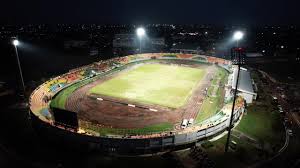
When the second leg kicked off, the atmosphere was thick enough to chew. The Rainbow Stadium was pulsing with the nervous energy of a community that dared to believe. But football, particularly in these high-stakes provincial clashes, is rarely a straightforward fairy tale. It is an exercise in suffering.
Pattani’s tactical setup was clear: suffocate the midfield, utilize Ekachai’s width, and rely on the chaotic brilliance of their Brazilian talisman, Marlon Silva. They found an early breakthrough to level the aggregate score, but the ghosts of Southern heartbreak are never far away. When Nongbua’s Jakrawut ghosted in at the back post to head home a contentious equaliser just before the interval, the spectre of failure loomed impossibly large.
What followed in the second half was a showcase of collective psychological endurance. The turning point did not manifest from a moment of intricate, Guardiola-esque attacking brilliance, but from the physical geometry and sheer bloody-mindedness of Kittisak in the Pattani goal. His sprawling, instinctive save to deny a certain Nongbua goal altered the atmospheric pressure of the stadium.
Then came the moment that should have broken Pattani. Deep into the second half, they were awarded a penalty. A chance to take the game to extra time. Marlon Silva stepped up. If one were to construct a prototype of the chaotic overseas centre bacj required to navigate the brutality of the lower Thai leagues, it would look strikingly like the Brazilian. But under the crushing weight of regional expectation, his nerve failed him. The penalty was missed. In these white-hot cauldrons, a missed penalty of that magnitude usually drains the life out of a side. Heads drop; legs turn to lead.
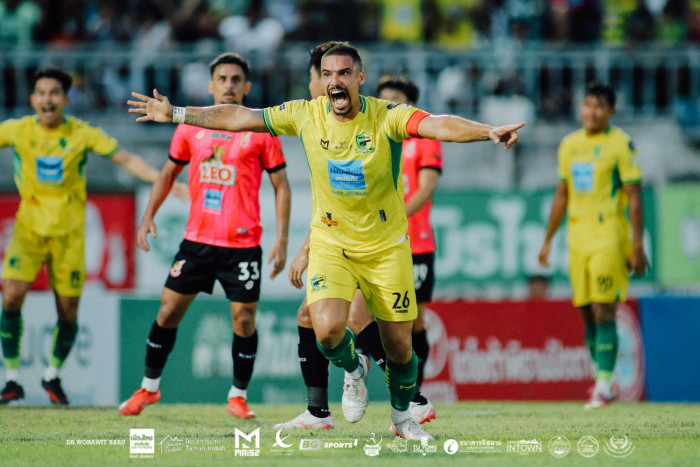
But Pattani somehow dragged themselves to a 2-1 victory on the night, levelling the tie at 3-3 on aggregate and forcing the game into extra time. The subsequent 30 minutes were a brutal, attritional war of attrition. Players were dropping with severe cramp, the tactical blueprints were torn up, and the game descended into a pure test of physiological and psychological survival. For 120 minutes, they battered each other to a standstill.
And so, it went to penalties. A shootout is an exhibition of sporting masochism. Both sides exhibited a bizarre, robotic perfection from the spot, scoring penalty after penalty. The tension was not a sharp spike, but a sustained, unbearable hum. It continued until the inevitable, tragic failure of nerve from Nongbua’s Japanese import, Kento, whose shot kissed the post and deflected wide.
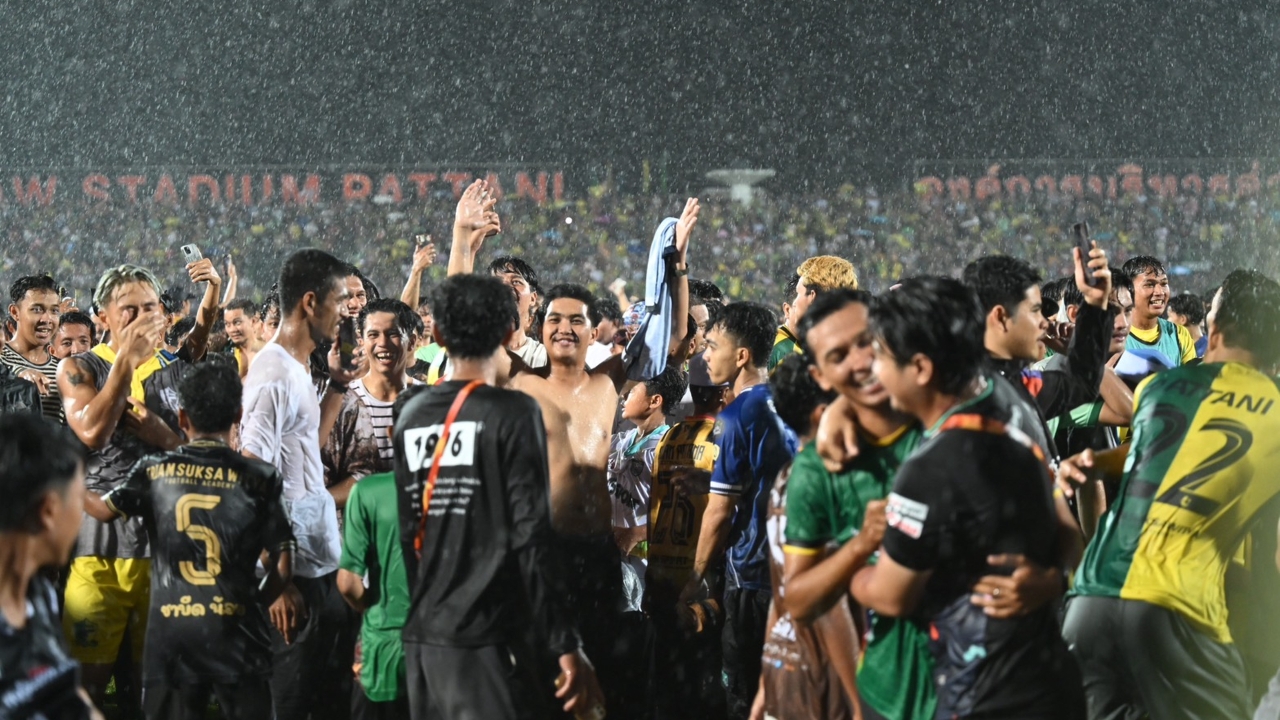
It was left to the last taker for Pattani to seal the deal and confirm their promotion. Astonishingly, stepping out of the centre circle, was Marlon Silva. The narrative arc was almost too heavy-handed for fiction. Having missed in regular time, a failure that forced his teammates through an extra half-hour of physical hell, he demanded the ball. He stepped up, a man carrying the aspirations of a forgotten region, and buried the decisive kick to win the shootout 8-7. When the net rippled, the Rainbow Stadium erupted in a primal, guttural roar. A decade of waiting, of isolation, and of feeling ignored by the footballing establishment, was extinguished in an instant.
The Geopolitical Shift
Beyond the immediate, tear-soaked euphoria, the geopolitical map of Thai League 1 has been fundamentally rewritten. If there is one undeniable truth about Pattani's promotion, it is this: it will give the logistics managers of Buriram United, Bangkok United, and Port FC profound, existential dread. Thai League 1 is, by its nature, a comfortably centralised entity. Elite teams are accustomed to short domestic flights, luxury coaches, and a relatively homogenous metropolitan routine.
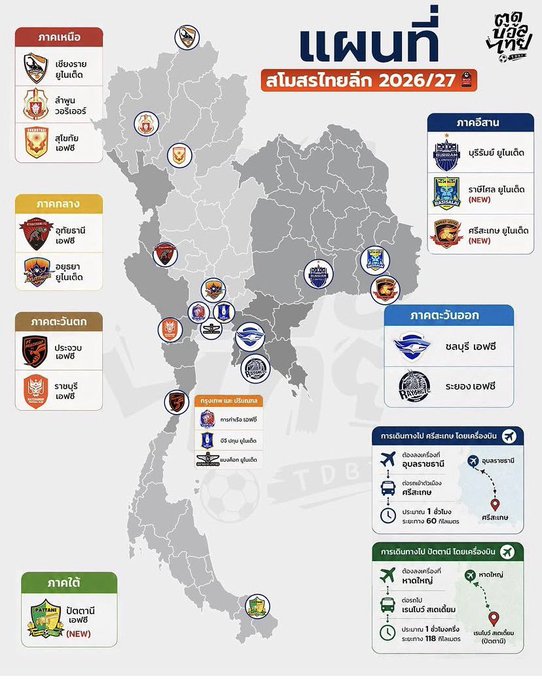
A trip to the Rainbow Stadium changes everything. We are talking about a fortress tucked away in the deep south, requiring flights to Hat Yai followed by extensive overland travel—a gruelling trek that completely disrupts the meticulously planned macro-cycles of elite squads.
| Thai League 1 Club | Road Distance to Pattani (km) |
|---|---|
| Chiangrai United | 1,820 km |
| Lamphun Warrior | 1,730 km |
| Sukhothai FC | 1,490 km |
| Nongbua Pitchaya | 1,480 km |
| Udon Thani | 1,470 km |
| Buriram United | 1,360 km |
| Nakhon Ratchasima | 1,210 km |
| Uthai Thani | 1,210 km |
| Bangkok United | 1,050 km |
| BG Pathum United | 1,050 km |
| Muangthong United | 1,050 km |
| Port F.C. | 1,040 km |
| Ratchaburi F.C. | 950 km |
| Rayong F.C. | 930 km |
| PT Prachuap F.C. | 760 km |
Visiting teams will not be playing against eleven men on a pitch; they will be playing against an entire peninsula. The heat is different down there; it clings to the skin. The air feels heavier. The hostility is visceral. Football in the south of Thailand is not a casual Friday evening diversion or an excuse to be seen in a VIP box. It is a vital, thrumming organ of civic pride. When top-flight football arrives in Pattani next season, the atmosphere will be deafening, tribal, and hostile in the most brilliantly sporting sense of the word. The 'Rainbow' moniker of the stadium belies the absolute gauntlet it represents.
With this historic promotion, the commercial landscape for the club has also fundamentally altered. By virtue of being the sole organic representative of the Deep South, Pattani holds a monopoly on regional loyalty. They are an incredibly attractive proposition for regional and national sponsors looking to tap into a fiercely unified demographic.
But the technicalities of T1 survival and recruitment can wait. The city of Pattani, and indeed the broader South, has earned its moment of unadulterated joy. They have defied the structural odds, navigated the most arduous playoff system in Southeast Asia, survived a 120-minute epic, and dragged themselves out of the provincial quagmire through sheer force of will. The comfortable hegemony of the central provinces is over; a new, vibrant, and intimidating frontier has just been opened. The South has risen, and they are bringing the noise with them.
Next tour: Port v Rayong
Saturday 24 October 2026 · ฿3,900 ฿2,999 per person, all inclusive. Ticket, private transport, pre-match briefing and a guide who knows the league inside out.
Book Your Place →
Simon,
I like the theme – but a few items that need clarification:
1. “When Nongbua’s Jakrawut ghosted in at the back post to head home a contentious equaliser just before the interval, the spectre of failure loomed impossibly large. Replays suggested a hint of offside—the sort of marginal, agonising call that, without the safety net of VAR in Thai League 2, tends to snap the psychological spine of a provincial side.”
T2 has VAR. Nothing at all contentious about Jakrawut’s goal. No protest from anyone in a Pattani shirt.
2. “Deep into the second half, they were awarded a penalty. A chance to win the game, to secure promotion without the lottery of extra time. Marlon Silva stepped up.”
This was the 81st minute – Pattani needed to score to take the game into extra time…..this penalty was not to win the game. Score the penalty but would still need another goal to avoid extra time.
3. “But Pattani somehow dragged themselves to a 2-1 victory on the night, levelling the tie at 3-3 on aggregate and forcing the game into extra time. ”
You underplay this – it was Marlon Silva – a centre back not a forward – scoring in the 95th minute – catharsis, divine intervention maybe, and what an emotional reaction. And from next to that same penalty spot!
4. “It was left to the eighth taker for Pattani to win it.”
It was Pattani’s fifth penalty. Shootout 5-4.
5. “The hostility is visceral”
Not really – they are among the kindest people I have met in Thai football and will pack out their stadium where kick off times will be arranged around the evening call to prayer.
Pattani FC, club and fans, are just what T1 needed !
Thanks for the clarification Rob, the beauty is in the detail. I would argue that hostility doesn’t mean someone is unkind when it comes to football it just echoes a tribalism that is not seen in Thai football elsewhere. Maybe something more akin to Indonesia. But you are right Pattani are just what T1 needs and T2 thankfully will have at least another deep south powerhouse to replace them.
Simon.
Getting the details right is the beauty.
There are too many basic inaccuracies in this piece. Too much reliance on poor AI?
Sadly more reliance on my poor note taking i think. I have edited alot of it already.