How a Luton Sunday Side Beat the Influencers to the Digital Punch.
I know Mark Watson well from our many conversations, and the Luton-born, Bangkok-based entrepreneur often ends sentences with a reassuring, slightly breathless refrain: "All is good." In the case of Futera United, his relentlessly ambitious, digitally-driven football project, it is fair to say that all is currently very good indeed.
The same, however, cannot be said for the club widely, and perhaps mistakenly, heralded as the vanguard of digital football. In recent weeks, the non-league bubble in which Hashtag United operated has burst in spectacular fashion. The Essex-based outfit, founded in 2016 by YouTube creator Spencer Owen, recently shocked their millions of followers by formally requesting voluntary relegation from the Isthmian Premier Division.
The harsh, unglamorous realities of Step 3 football in the English pyramid, mounting travel costs, soaring wage bills, and the sheer logistical grind, have proven financially unsustainable for the social media darlings. To soften the blow of this deliberate retreat, the club has resorted to offering free renewals to season ticket holders.
The mainstream press has understandably framed it as a harsh reality check for influencer-led football. Yet, it would be disingenuous to write Hashtag off entirely. In a recent conversation with a club representative and former player, a pivot towards traditional footballing infrastructure was made clear. The club are working to a new, grounded plan and remain steadfastly confident of coming back stronger. The crux of this revival hinges on the physical, rather than the digital. They are actively developing a new permanent home near Redbridge tube station, which will also house their administrative offices. The objective is to build a proper, localised physical support base to supplement an online following that is inevitably suffering from market saturation. As more and more clubs attempt to replicate their docu-style, rags-to-riches narrative, the digital landscape has become intensely crowded. Hashtag’s move is a tacit admission that while YouTube subscribers are theoretically infinite, the funds and loyalty required to sustain a competitive, semi-professional side in the home counties are distinctly finite, and heavily reliant on actual turnstiles.
Yet, the great irony of Hashtag United’s current existential crisis is that they were never the original architects of the model they are famous for. What they are attempting to salvage is, in fact, a less innovative version of a blueprint drawn up years earlier. Long before Spencer Owen coined a hashtag, Futera did it first.

The Man Behind the Metaverse
To understand the sheer audacity of Futera United, one must first understand Mark Watson. As the CEO of Futera Ltd, a premium trading card behemoth that has held licenses with European royalty like Barcelona, Liverpool, and Arsenal since 1989, Watson operates within the elite, highly corporate echelons of the global game. But at heart, he remains a footballing obsessive driven by a fiercely pure, almost childlike ambition.
In conversation, there are shades of David Brent to Watson, though entirely in the kindest, most endearing sense of the comparison. He possesses that same earnestness, a slight, charming awkwardness, and an unrelenting, un-ironic belief in his own grand vision when others might roll their eyes. He readily admits that if he were formally tested, he is quite sure he would be found to be on the autism spectrum. This hyper-focused, singular wiring is likely the very reason Futera United exists. While others grow out of the dictatorial fantasies of Subbuteo and the meticulous spreadsheet management of Football Manager, Watson’s passion simply scaled up. He is not doing this to be a saviour of Thai football, nor is it a cynical marketing exercise; he is doing it purely to ‘complete’ the game.
It is a love that requires careful domestic diplomacy. His wife needs to be constantly, and gently, sated regarding exactly how much of the family’s wealth is being diverted into the unpredictable vacuum of the Thai football pyramid. But Watson’s conviction is utterly magnetic.

The Black Swan Epiphany
To trace the true origins of this interactive, fan-driven football model, you have to rewind to a hungover Sunday morning in 2008. The setting was not a shiny digital studio in London, but a hotel in Luton following a stag night. Watson and his mates were gathered over breakfast, and the conversation inevitably turned to the dire plight of their hometown club, Luton Town. The Hatters had just been relegated to League Two and were facing a catastrophic 30-point deduction.
According to Watson, everyone around the table had a very loud opinion, but no one was willing to actually do anything. Frustrated, he challenged them to take action. The response was predictably cynical: what could a few blokes in a pub actually do? Watson fired back. With enough people, he argued, things could change. Democracy could work in football.
He was laughed out of the fry up. But a seed had been planted. To prove his point, Watson offered to fund all the costs for his friends’ Sunday League team. In 2009, he took the team over, operating out of the Black Swan pub, and rebranded them Futera United.

Pink Boots and Tripods
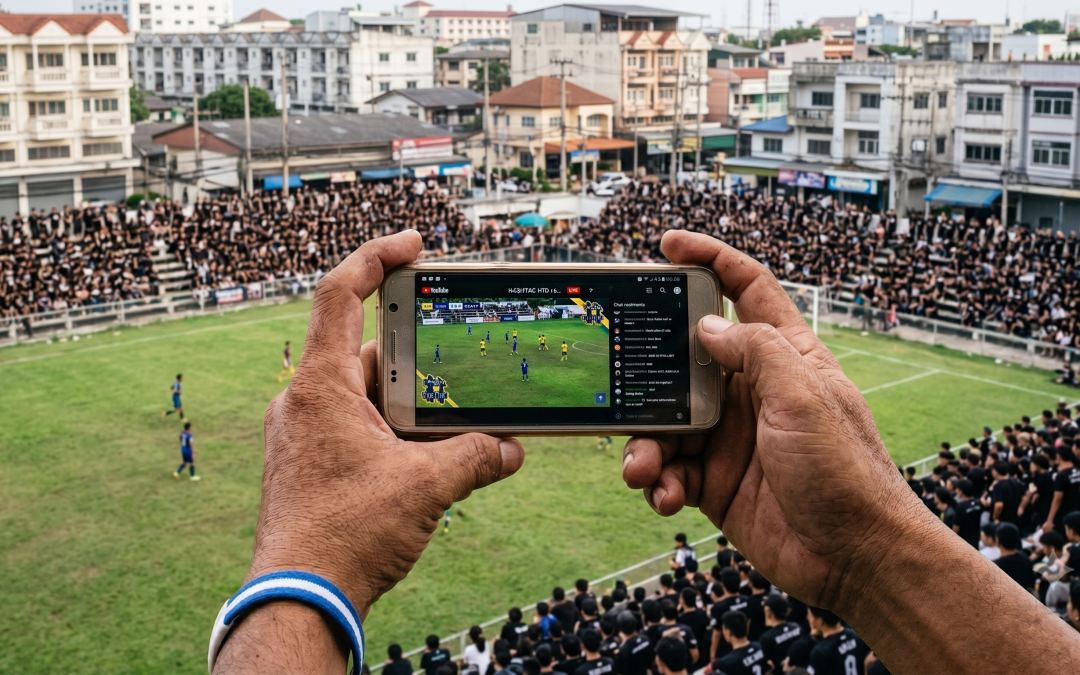
For two seasons, Futera United competed in the local Bedfordshire leagues, but their audience was global. In an era long before Twitch, high-speed 4G, or ubiquitous smartphones, they streamed all their games on a platform called Ustream. The broadcasting rig consisted of old iPhones strapped to makeshift tripods scattered across the pitch.
Fans from around the world logged in and voted on in-game tactical changes and substitutions via Facebook. The democratic mandates were then frantically relayed to the coaches on the touchline.
"The feeds were awful, to be honest," Watson recalls with a laugh. He was actually working in Kuala Lumpur at the time, managing this Bedfordshire Sunday League project entirely remotely. "I remember we once commented on the feed about a player’s pink boots. Suddenly, everyone in the chat was chiming in with messages about how much they liked them. It was all a complete fabrication, the feed was so blurry you couldn't see anything, let alone the colour of the boots."
The experiment was chaotic, unprecedented, and genuinely revolutionary. It caught the eye of an American Sports Network, who filmed a documentary on the project. Tragically, in the days before cloud storage, the footage was lost to time.

The Bangkok Blueprint
In 2011, Watson relocated permanently to Bangkok. He quickly realised that the lower operational costs in Thailand meant he could take his Sunday League blueprint and apply it at a fully professional level.
They forged a partnership with an established local club, Seeker FC, rebranding the side as Futera Seeker and entering what is now Thai League 3. However, bolting a revolutionary, internet-led democratic system onto an established, traditional football club proved to be a profoundly fractious relationship. Established football men do not take kindly to Facebook comments dictating their half-time substitutions. After one grueling season, Watson withdrew his backing. Ironically, that club is now Pathum Thani FC, who currently compete in the exact same league as Futera today.
The dream lay dormant until 2021, when Futera United was officially reborn as its own distinct entity. They started from the very bottom, plying their trade in the Amateur Bangkok League, quietly honing the interactive model away from the spotlight.
By 2024, they were ready for the step up and applied for entry into the Thailand Semi-Pro League (TSP). In a twist of bureaucratic absurdity typical of lower-league football, they were rejected. The stadium they submitted had one shower too few to meet the FA's stringent regulations. Watson, ever the pragmatist, offered to personally pay to plumb a new one in immediately. The authorities declined.
They bided their time, and in 2025, they were finally admitted.

The T3 Revolution
Today, operating as Futera United, the club finds itself navigating the notoriously unforgiving waters of Thai League 3 (T3). Their presence in the division this season was, admittedly, fortuitous. When the champions of the TSP Central region were unceremoniously eliminated last year due to off-field irregularities, and the runners-up declined the promotion spot, Futera were handed an unexpected golden ticket.
In the lower leagues of any country, being unexpectedly bumped up a division is usually a recipe for a grueling, relegation-threatened campaign. Instead, Futera have thrived. Following an initial period of acclimatisation, their form in the second leg of the season has been blistering.
This success is not a gimmick. It is the product of a beautifully balanced coaching triumvirate. At the helm is Phisan Ramrai, known universally as Coach Den. A former Thai national team player with an AFC Champions League title to his name, Den provides an uncompromising, old-school winning mentality. He is flanked by Breeze, his young, tactically astute assistant who bridges the generational gap. Completing the triangle is Craig Livingston, a UEFA A-Licensed Northern Irishman who serves as the data coach, tasked with translating the club’s digital ethos into match-winning metrics.
But the true turning point of this current season, the catalyst that dragged a plucky digital experiment up to elite physical standards, was the hiring of a dedicated fitness coach. In the suffocating humidity of the Thai third tier, tactics only take you so far. By bringing the squad's physical levels up to a professional standard, Futera have been able to ruthlessly execute Livingston's data models and Den's defensive rigour for a full ninety minutes.

The Metaverse Meets Grass
They are doing all of this whilst operating in an entirely different commercial stratosphere to their rivals. Affectionately dubbed the "TikTok team" by local media, Futera United amassed an astonishing 15 million views on the platform last season alone. They have successfully built a club in the metaverse that functions ruthlessly well on actual grass.
Inevitably, the soaring digital metrics and charismatic ownership draw breathless comparisons to a certain Welsh club owned by Hollywood royalty. Futera are frequently, and lazily, cited as Thailand’s answer to Wrexham. When asked about the parallels, Watson deflects with his trademark dry wit.
"I’m far better looking than Ryan Reynolds, though," he jokes.
It is a good line, but the comparison is fundamentally flawed. Wrexham’s revival relies on the injection of immense Hollywood capital. Hashtag United’s initial rise relied on a YouTube algorithm that eventually could not cover the invoices of Step 3 football.
Futera United, conversely, is built differently. Born from a hungover argument in a Luton hotel, honed on the mud of Sunday League, and refined in the heat of Bangkok, they are proving that a club can be both a digital phenomenon and a sustainable, promotion-chasing reality. While the supposed innovators in Essex are asking the FA for permission to drop down a league, the original pioneers in Thailand are looking strictly upwards. All, it seems, is very good indeed.
Next tour: Port v Rayong
Saturday 24 October 2026 · ฿3,900 ฿2,999 per person, all inclusive. Ticket, private transport, pre-match briefing and a guide who knows the league inside out.
Book Your Place → Buriram United
 Uthai Thani
 Bangkok United
 Prachuap
 Port
Port Ratchaburi
 Rayong
 Ayutthaya United
 Sisaket United
 Pathum United
 Chiangrai United
 Pattani
 Sukhothai
 Rasisalai United
 Lamphun Warrior
 Chonburi