
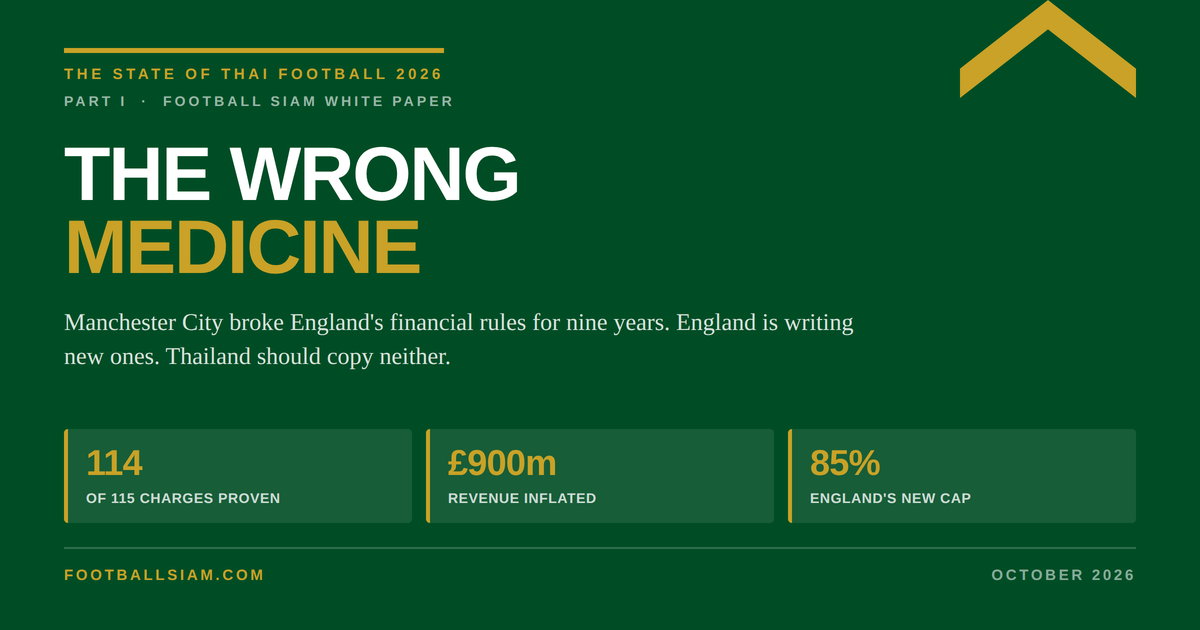
On 29 September an independent commission found Manchester City guilty of 114 of the 115 charges brought by the Premier League: nine seasons of sham sponsorships, disguised owner money and misstated accounts worth more than £900m. England is already tearing up the rules City broke and replacing them with new ones. This paper asks what would happen if either set of rules were applied to Thailand, and argues that the answer is not what the reformers would hope. English rules would benefit one club, widen the gap beneath it and do nothing about the problem that actually kills Thai clubs.
Key findings
- Manchester City were found to have inflated their revenue by more than £900m between 2009-10 and 2017-18 by having their owners quietly top up what sponsors were paying. In England that is the gravest offence in the rulebook. In Thailand, owner money dressed as sponsorship is how most clubs are funded.
- The Premier League's Profitability and Sustainability Rules (PSR), which allowed losses of £105m over three years, are being replaced from 2026-27 by a Squad Cost Ratio: clubs may spend 85 per cent of their football revenue on wages, transfer amortisation and agents. A proposal to cap spending at five times the bottom club's central income was voted down 12-7.
- Applied to Thailand, a revenue-based spending cap would be a charter for Buriram United, the one club with substantial commercial income of its own, and a ceiling on everyone trying to catch them. The gap that five straight titles has opened would become law.
- Thailand's problem is not owners spending too much. It is owners who stop paying. Rules built for England's disease would not treat Thailand's.
- What Thailand needs is solvency regulation, not spending regulation: wages-paid tests, working-capital requirements and a J.League-style licensing rule that removes the licence of clubs that cannot balance their books, with the money to make it work. Part II of this series sets out where that money could come from.
1.Introduction
The biggest financial case in the history of English football ended, after seven years of investigation and a 42-day hearing, with a document nobody outside the room has yet read in full. On 29 September 2026 an independent commission found Manchester City guilty of 114 of the 115 charges the Premier League brought against them in February 2023. Every one of the financial charges was proven. Only a single count relating to co-operation with the investigation fell.
The substance is simple enough to fit in a sentence. Between 2009-10 and 2017-18 the commission found that City's sponsors paid part of what they appeared to pay, the club's Abu Dhabi owners quietly paid the rest, and the whole amount was booked as commercial revenue, inflating the club's income by more than £900m and allowing it to spend far more on players than the rules permitted. There were sham contracts, accounts that did not show the club's true position and, according to the Premier League, a sustained refusal to co-operate.
Richard Masters, Premier League chief executive: "The club systematically broke Premier League Rules for nearly a decade."
City say they are "disappointed and surprised", insist they are innocent and are appealing to a new three-person panel. The sanction, which the same commission will decide separately, could be anything from a fine to a points deduction to expulsion from the league. Everton lost ten points, reduced to six on appeal, for a single breach of the old loss limits. Nottingham Forest lost four. One analyst's suggestion was to "add a zero". Even 40 points would have put last season's City 18th.
This paper is not about whether City deserve what is coming. It is about a question closer to home. The Premier League is tearing up the rules City broke and replacing them with something new. If Thailand wanted rules of its own, which set should it copy, and what would happen if it did?
2.The rules City broke, and the rules replacing them
The Profitability and Sustainability Rules, PSR, were a loss limit: a club could lose no more than £105m over three seasons, provided the owner covered the losses with equity. They were simple, and they were gamed. Chelsea sold a hotel to a sister company for £76.5m and their women's team to another for £200m, and both counted as profit. Clubs sold academy graduates, whose book value was zero, to balance the books. Everyone found that the real test was not whether you spent too much but whether your accountants were quicker than the regulator's.
On 21 November 2025 the clubs voted PSR out. From 2026-27 the Premier League runs on a Squad Cost Ratio, SCR: a club may spend up to 85 per cent of its football revenue, plus net profit on player sales, on player and head-coach wages, amortised transfer fees and agents' fees. Above 85 per cent there is a levy. Above 115 per cent there is a fixed six-point deduction plus a point for every £6.5m over. Clubs in European competition already live with Uefa's stricter 70 per cent. Alongside it sit three Sustainability and Systemic Resilience tests: a working-capital floor of £12.5m, a liquidity stress test of £85m, and a positive-equity test that tightens each year.
A third proposal, Top to Bottom Anchoring, would have capped every club's squad spending at five times the central payments received by the bottom club. The players' union threatened to sue. The clubs voted it down, seven for, twelve against, one abstention. The Premier League's statement said simply that there was "insufficient support".
England's financial rules, old and new
| PSR (to 2025-26) | SCR and SSR (from 2026-27) | Anchoring (rejected) | |
|---|---|---|---|
| What it measures | Losses over a rolling three years | Squad cost as a share of football revenue, plus three solvency tests | Squad cost against the bottom club's central income |
| The limit | £105m | 85% (Uefa: 70%) | 5 times the bottom club's TV and prize money |
| Penalty | Points deductions decided case by case (Everton 6, Forest 4) | Levy above 85%; six points plus one per £6.5m above 115% | Never agreed |
| Who it favours | Owners able to absorb losses; clubs with assets to sell | Clubs with the largest revenues | Smaller clubs; opposed by the biggest and by the players' union |
| Vote | Being retired | Passed with the minimum 14 votes | Defeated 12-7, one abstention |
Sources: Premier League statement, 21 November 2025; Sky Sports; Brabners.
Note what changed and what did not. PSR asked how much you lost. SCR asks how much you earn, and lets you spend accordingly. Owner money no longer counts as revenue under either, which is exactly the point on which City were convicted. But the mid-table clubs who argued for anchoring noticed something else: a cap set as a percentage of revenue is a cap set by whoever already has the most revenue. Their fear was that the new rules would make it harder, not easier, to catch the top six. They lost.
3.The thought experiment: City's crime in Thailand
Now run the Manchester City test on Thai League 1.
In England, an owner secretly topping up a sponsor's payment to make the club look richer than it is constitutes the gravest offence in the rulebook. In Thailand, owner money dressed as sponsorship is not a scandal. It is the industry's operating model. Clubs carry their owner's company on the shirt and, in most cases, in the name, which is why this site refuses to use those names and calls Bangkok Glass Pathum United simply Pathum United, PTT Prachuap simply Prachuap. The sponsor and the owner are frequently the same money. Nobody asks what the shirt deal is "really" worth, because everyone knows the answer: it is worth whatever the owner decides to put in this year.
Apply the Premier League's fair-value test, which asks what an independent company would have paid for the same sponsorship, and most of the division is in the dock. The club budget that looks like 300 million baht of commercial income is, on inspection, 50 million of genuine sponsorship and 250 million of the chairman's goodwill. Under English rules the 250 million would be struck out of revenue, the wage bill would exceed the ratio, and the points would start coming off.
That is not an argument that Thai owners are criminals. It is an argument that the English rules are built for a problem Thailand does not have. City's offence was concealment: pretending that owner money was market money in order to spend more than the rules allowed. Thai clubs do not conceal that their owners fund them. They advertise it. The problem in Thailand is not that the patron's money is hidden. It is that the patron's money is all there is, and one day the patron stops.
4.The thought experiment, part two: SCR in Thailand
Suppose Thailand skipped PSR and went straight to the new model: 85 per cent of football revenue, with owner contributions excluded. Who wins?
One club, overwhelmingly. Buriram United are the only side in Thailand whose revenue would survive a fair-value test more or less intact. They have a 32,600-seat stadium, built in 256 days and full most weeks. They have a title sponsor, Chang, whose deal was reported at a billion baht over five years when the ground was renamed in 2017, and which is a genuine third-party arrangement rather than a chairman's company paying itself. They have continental prize money every year, merchandise that sells across the country and, as long ago as 2013, reported profits in the hundreds of millions of baht. Newin Chidchob's money built all of that, but the point is that it has become self-sustaining in a way no other Thai club's has.
Under an 85 per cent rule Buriram would be allowed to spend several times what anyone else could. The club with the most genuine revenue would be handed the biggest wage ceiling, and the clubs trying to catch them, who can only do so by spending a patron's money, would be forbidden from doing the one thing that has ever closed a gap in Thai football. Buriram have won twelve Thai League 1 titles, eleven of them since moving to Isan in 2010, and the last five in a row. A revenue-based spending cap would not threaten that dominance. It would notarise it.
Why a revenue cap entrenches the leader
| Club profile | Where the money comes from | Under an 85% rule |
|---|---|---|
| The champions | Large stadium, national title sponsor, continental prize money, merchandise | Most of it counts as revenue. The wage ceiling is high and rises with success. |
| A mid-table club | Modest gate, owner's company on the shirt, FA subsidy of 15m baht | The owner's sponsorship is written down to fair value. The ceiling falls. Catching up becomes a rule breach. |
| A promoted club | A provincial politician's or businessman's cheque book | Almost nothing counts. The club that just earned promotion on merit cannot afford a top-flight squad. |
Illustrative profiles, not club accounts. The mechanism is the point: a cap set as a share of revenue is set by whoever already has the most revenue.
What about the alternative the Premier League rejected? Anchoring sounds fairer: a cap at five times what the bottom club receives from the centre. Try the arithmetic. Every Thai League 1 club receives 15 million baht a season from the FA. Five times that is 75 million baht. A ceiling at that level would not make the league more competitive. It would gut the champions' squad, strip the division of the foreign players who make it watchable, and still do nothing for the club at the bottom, whose problem is not that its rivals spend too much but that its own owner has stopped paying wages.
5.Do we need rules like these?
So, the question the series exists to ask. England has spent two decades building ever more elaborate ways of stopping rich owners spending their money, and has just convicted the richest of them for doing it anyway. Should Thailand want the same?
The honest answer is that England and Thailand have different diseases. England's is too much money, and owners who disguise where it came from. The symptom is a club that overspends and gets away with it. Thailand's is too little money, and owners who stop paying. The symptom is a club that does not overspend by any English measure, that may be spending a tenth of Buriram's budget, and that still collapses in July because the man who was paying for it lost an election or lost interest. As Part II of this series sets out, at least two Thai League 2 clubs have yet to pay their players this season.
Spending rules do not treat that. A club that cannot pay 40,000 baht a month to a squad player is not breaching a squad-cost ratio; it is breaching the basic contract between employer and employee, and no percentage will fix it. What treats it is solvency regulation: the unglamorous half of England's new system, the SSR tests, and the half nobody in Thailand is talking about.
There is a model for it closer to home. Since 2012 the J.League has run a club licensing system under which a club that records net losses for three consecutive years, or whose liabilities exceed its assets, does not receive a licence for the following season. It does not tell clubs how much to spend. It tells them they must be able to pay for what they spend, and it removes them from the league if they cannot. Japanese clubs have been promoted and denied promotion on it. It is a rule about staying alive, not about keeping up.
What Thailand should regulate instead
| Rule | What it does | Borrowed from |
|---|---|---|
| Wages-paid test | Every club proves, quarterly, that players and staff have been paid. Failure withholds the next FA distribution and triggers a published notice. | Club licensing practice across Asia; the USL's player protections (Part II) |
| Working-capital floor | Before a licence is granted, the club shows it holds enough cash or guaranteed funding to cover a defined share of the season's wage bill. | Premier League SSR working-capital and liquidity tests |
| Three-year rule | Three consecutive years of net losses, or negative equity, and the licence is refused for the following season. | J.League club licensing, since 2012 |
| Related-party disclosure | Sponsorships from companies connected to the owner are declared and independently valued. Not to punish them, but so the league knows exactly how dependent each club is on one person. | Premier League and Uefa fair-value rules, used for transparency rather than sanction |
| Owner guarantee | Where a club depends on a patron, the patron signs a personal or corporate guarantee for the season's wages. Walk away mid-season and the guarantee is called. | Football Siam proposal |
A Football Siam proposal for discussion. None of these rules caps what a club may spend. All of them govern whether it can pay for it.
None of this caps ambition. A patron who wants to build the next Buriram in Chiang Mai or Songkhla or Pattani remains free to do so, and the league should want him to. What he is not free to do is build it on a promise, walk away in the spring and leave thirty players and their families to find out from the newspapers.
6.The counter-argument
It should be said plainly that there is a case for spending rules in Thailand, and it is Buriram themselves. Five titles in a row is not healthy for any league, and the clubs chasing them have a reasonable complaint that the only way to compete is to find a richer patron, which is precisely the arms race England spent twenty years trying to stop. A squad-cost ratio would at least make Buriram's rivals live within their means.
The reply is that living within their means is not the problem. Thai clubs already spend less than they would like; what they lack is means. A rule that holds everyone else down while the leader is allowed to spend to the limit of a revenue nobody else can match is not competitive balance. It is a moat with a regulator standing guard on it. If Thailand wants a more competitive top flight, the answer lies in giving the chasing clubs more genuine revenue, which is a question of how the league's central income is generated and shared, and that is the subject of Part II.
7.Conclusion
Manchester City will be punished, probably severely, for pretending that their owner's money was somebody else's. It is a verdict about honesty, and it is right that England has rules capable of delivering it. But the lesson for Thailand is not "we need rules like these". It is to understand what the rules are for.
England's rules are designed to restrain owners who have too much and hide it. Thailand's clubs are dying of owners who have too little, or who have enough and stop. A revenue-based cap would hand the strongest club in the country a legal advantage and freeze the rest in place. An anchored cap would hollow out the league's top without saving its bottom. Neither addresses the unpaid squad in Thai League 2.
The right question for Thailand is not how much a club may spend. It is whether it can pay for what it has already promised, and what happens to the players when it cannot. That is a question about solvency, about licensing with teeth and, ultimately, about where the money comes from. Part II of this series looks at a league that has just answered it.
References
- CBS Sports, "Premier League commission finds Manchester City guilty on 114 charges", 29 September 2026
- Al Jazeera, "Man City guilty of all serious financial breach charges", 29 September 2026
- Al Jazeera, "What will happen to Man City after the Premier League's guilty verdict?", 30 September 2026
- Sky Sports, "Man City Premier League charges: appeal process, punishment hearing and what happens now"
- Premier League, "Premier League statement: New financial system", 21 November 2025
- Sky Sports, "Premier League clubs approve new Squad Cost Ratio rules to replace PSR", November 2025
- Brabners, "Out with PSR, in with SCR: key takeaways for the Premier League's new financial era"
- Kaohoon International, "ADVANC, GULF and JAS Secure Exclusive Rights for Thai Football League Broadcasts", June 2025
- TCIJ, "Concern felt about prosperous Thai League facing bubble crisis", December 2015
- Wikipedia, "Buriram United F.C."
Next tour: Port v Rayong
Saturday 24 October 2026 · ฿3,900 ฿2,999 per person, all inclusive. Ticket, private transport, pre-match briefing and a guide who knows the league inside out.
Book Your Place → Buriram United
 Uthai Thani
 Bangkok United
 Prachuap
 Port
Port Ratchaburi
 Rayong
 Ayutthaya United
 Sisaket United
 Pathum United
 Chiangrai United
 Pattani
 Sukhothai
 Rasisalai United
 Lamphun Warrior
 Chonburi