
There is a profound, almost surreal cognitive dissonance in watching a seventeen-year-old boy, whose formative footballing years were spent sweating on the provincial pitches of Ratchaburi and the concrete courts of Bangkok, step onto the immaculate turf of the Allianz Arena.
On 6 March 2026, when Bayern Munich introduced Maicon Cardoso in the 61st minute of their 4-1 dismantling of Borussia Mönchengladbach, the collective gasp heard wasn’t just in Bavaria. It echoed across Thailand. At just 17 years and 148 days old, the precocious forward looked entirely unburdened by the occasion. Just days later, he was terrorising the German fourth division, starting for Bayern’s reserve team and lashing home a 28th-minute opener in a comfortable 2-0 victory over Augsburg.
For Thai football fans, Maicon is the darling they desperately want to claim. He speaks fluent Thai, understands the culture intrinsically, and possesses the kind of raw, unteachable flair that fills stadiums. Yet, the clamour to hand him a Thai passport and rush him into the War Elephants’ squad is a fundamentally flawed pursuit—legally impossible, philosophically questionable, and ultimately, a misunderstanding of his incredible trajectory.
The Patriarch: Douglas Cardoso’s Thai Odyssey
To truly understand the Maicon phenomenon, one must first look at his father. Douglas Cardoso was the quintessential footballing journeyman, a Brazilian striker who found his spiritual and professional home in the Thai League. Arriving in the kingdom to ply his trade, Douglas didn’t just treat his contracts with clubs like Buriram PEA and Ratchaburi as temporary mercenary assignments; he immersed his family in the local landscape.
Maicon arrived in Thailand at the tender age of two. For those of us who have followed the domestic game for the last decade and a half, the sight of a tiny Maicon toddling onto the pitch after the final whistle of a Ratchaburi fixture is a familiar memory. There are countless photographs buried in the archives of Thai sports photographers showing this diminutive Brazilian kid, swimming in an oversized replica shirt, kicking a ball around the centre circle while his father completed his post-match media duties.
This visual is crucial. It underscores that Maicon was not imported into Thailand as a fully formed prospect; he is a product of its environment. He learned his trade on the same sun-baked pitches, in the same suffocating humidity, and against the same local kids as any other Thai prospect. Culturally, he is as much a product of Ratchaburi and Bangkok as he is of Brazil.
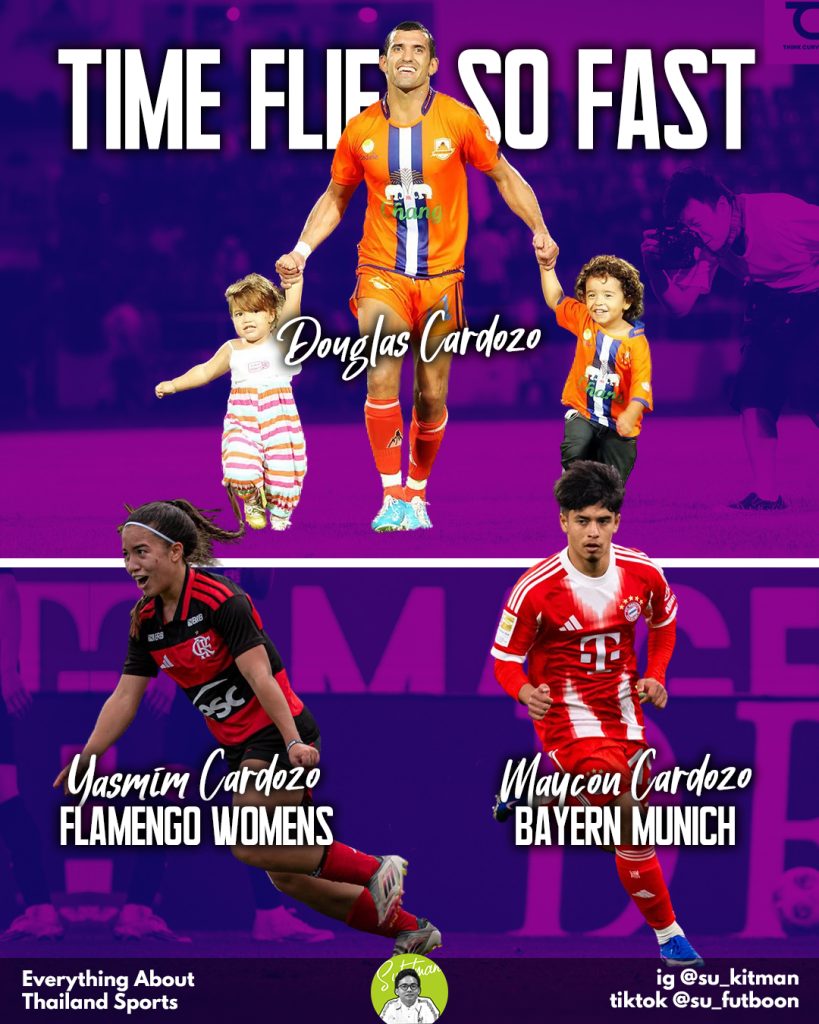
A Family Affair: Yasmin and the Parisian Connection
The Cardoso family’s footballing pedigree extends beyond just the men of the house. Maicon’s twin sister, Yasmin Cardoso, is currently carving out her own formidable path in Europe, refining her game within the elite Paris Saint-Germain youth setup in France.
The presence of both siblings in two of Europe’s absolute premier development programmes—Bayern Munich and PSG—cements the family’s incredible trajectory. The Cardosos didn’t just pass through Thailand; they used the Thai footballing ecosystem as the launchpad for a full-scale European takeover. It is precisely why Maicon and Yasmin’s current success feels so incredibly personal to the Thai public. They are, in every developmental sense, local kids who have conquered the continent.
A Product of the Thai System
Maicon’s journey from a toddler on the touchline to a prospect at Säbener Straße is a testament to the evolving infrastructure of Thai youth football. He didn’t bypass the local system; he navigated it entirely.
Starting at the Ratchaburi FC academy, he learned the chaotic, transition-heavy style that characterises the provincial game. He then moved to the capital, becoming a standout player for Bangkok Christian College—an institution steeped in Thai schoolboy football folklore and renowned for its intense, fiercely competitive tactical environment. Eventually, he entered the Sport Thai-Bavaria (STB) Academy, the official partner programme of Bayern Munich in Thailand.
Interestingly, youth coaches at STB have noted that Maicon was not necessarily the biggest or most physically dominant player in his age group. What set him apart, however, was an insatiable drive and a level of dedication that far outstripped his peers. Standing at just 165 centimetres, he used his low centre of gravity, technical brilliance, and a relentless work ethic forged in the Thai schoolboy leagues to catch the eye of Bayern’s global scouting network. He learned how to survive the physicality of older Thai defenders, a trait that is now serving him beautifully against seasoned German professionals.
The Bureaucratic Wall: Why Naturalisation is a Fantasy
Naturally, as Maicon began tearing up youth tournaments in Europe and eventually secured a long-term contract extension with Bayern Munich, the national conversation shifted to naturalisation. Could the Football Association of Thailand (FAT) secure his international allegiance before the rest of the world caught on?
The short, brutal answer is no. Thai nationality law is notoriously stringent, prioritising blood and soil over cultural assimilation and sporting convenience.
As legal analysts have repeatedly pointed out, the barriers are currently insurmountable. Firstly, Maicon was born in Brazil; he possesses no claim to “nationality by birth.” Secondly, the standard route of naturalisation requires the applicant to be of legal age (20 years old under Thai law), to hold a legitimate occupation with a stable income within the country, and to have resided in Thailand continuously for at least five years immediately prior to the application.
At 17, he is a minor. Furthermore, his relocation to Munich effectively severs the continuous residency requirement. Even the much-touted “special case” provision—granting citizenship for outstanding contributions to the nation—rarely supersedes the fundamental requirement of abandoning one’s original nationality. For a rising star possessing a Brazilian passport, relinquishing it for a Thai one is a career decision no sensible agent would sanction. The law is a bureaucratic wall, and it remains firmly shut.
The Integrity of the War Elephants
Perhaps, however, this legal roadblock is a blessing disguised in bureaucratic red tape. Across Southeast Asia, the naturalisation of foreign-born players has become a frantic arms race. Indonesia, under Shin Tae-yong, has effectively assembled a squad drawn entirely from the Dutch diaspora, fielding XIs where the vast majority of players were neither born nor raised in the archipelago. Other regional rivals scour the globe for anyone with a tenuous ancestral link to bolster their World Cup qualification hopes.
Thailand has largely resisted this synthetic approach to squad building. While the War Elephants warmly welcome dual-nationals with genuine Thai heritage—such as the brilliant SV Elversberg defender Nicholas Mickelson—they have avoided the quick-fix strategy of handing passports to players with no blood connection to the country simply because they are highly competent at football.
This reluctance preserves a vital sense of identity. If Thailand were to bend its own constitutional laws merely to cap a talented teenager, it would send a catastrophic message to the domestic academy system. It implies that organic development is secondary to administrative loopholes. The FAT must focus on cultivating the next generation of domestic talent, building infrastructure, and raising the overall standard of the Thai League, rather than lobbying the government for a sporting shortcut. Thailand is right to avoid naturalising players who have no inherent legal right to the passport. The soul of a national team cannot be bought, and it should not be legislated into existence.
The Seleção Beckons
There is also a necessary dose of realism required regarding Maicon’s ceiling. The romantic notion of him leading the line for Thailand at the Rajamangala National Stadium ignores the sheer magnitude of what he is currently achieving in Europe.
Getting minutes for Bayern Munich’s first team under Vincent Kompany at 17 is not merely an achievement; it is a global klaxon. You do not break into one of the most demanding squads in European football without registering on the radar of the Confederação Brasileira de Futebol (CBF). Brazil’s scouting network is exhaustive, and a Brazilian forward making waves in Bavaria will already be pencilled into their youth team tracking systems. Making a debut for a club of Bayern’s stature at such a tender age inevitably points towards the famous yellow shirt of Brazil.
Thai football fans should not view Maicon’s legal ineligibility as a missed opportunity, but rather as a point of immense pride. He may never wear the blue of the War Elephants, but his footballing DNA was forged in the heat of Ratchaburi and Bangkok. When he inevitably steps onto the world stage, he will do so as a Brazilian talent, but one undeniably polished by Thailand. That, in itself, is a victory worth celebrating.
Next tour: Port v Rayong
Saturday 24 October 2026 · ฿3,900 ฿2,999 per person, all inclusive. Ticket, private transport, pre-match briefing and a guide who knows the league inside out.
Book Your Place → Buriram United
 Uthai Thani
 Bangkok United
 Prachuap
 Port
Port Ratchaburi
 Rayong
 Ayutthaya United
 Sisaket United
 Pathum United
 Chiangrai United
 Pattani
 Sukhothai
 Rasisalai United
 Lamphun Warrior
 Chonburi