
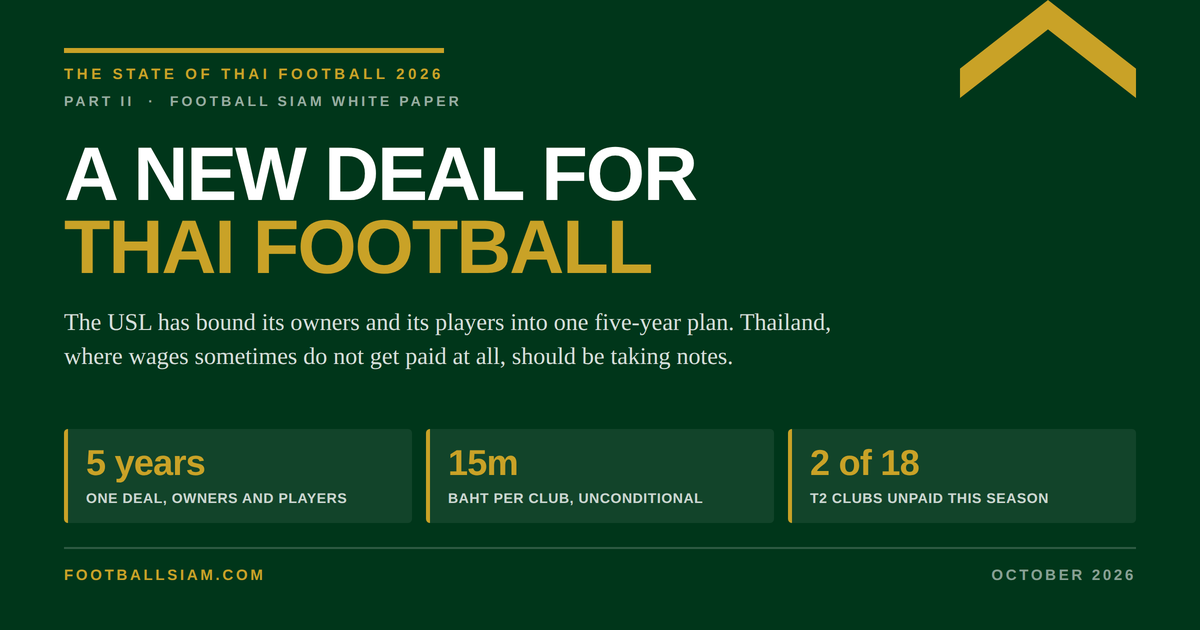
In September the United Soccer League bound its club owners and its players into the same five-year plan. Thai football, where central money flows one way and wages sometimes do not flow at all, has never done either, and this season the strain is showing. This paper sets out what the Americans agreed, how Thai football is funded today, the state of the league in 2026-27, a model Thailand could adopt, a roadmap to get there by 2029-30, and the hurdles in the way.
Key findings
- The USL now shares national league revenue with its clubs and has a five-year collective agreement with its players (2026 to 2030), both settled before promotion and relegation arrive in 2028.
- Thai clubs receive a fixed subsidy, not a share: 15m baht a season in Thai League 1, 4m in Thai League 2 and 1.25m in Thai League 3. Owners gain nothing when the league earns more.
- Those subsidies total roughly 400m baht a year, more than the 350m baht annual broadcast fee. A straight percentage share would leave many clubs worse off today.
- Thai players have a players' association but no collective agreement, no league-wide minimum wage and no guaranteed pay if their club folds.
- The 2026-27 season shows the cost. At least two of the 18 Thai League 2 clubs have yet to pay their players this season. The new foreign player rules in Thai League 1 have pushed Thai players down a division on far lower wages, and many clubs in the second tier and below have given up on anything beyond survival.
- The current broadcast deal ends after 2028-29. The next rights cycle is the natural moment to introduce a shared, conditional, five-year model.
1.Introduction
American football's second tier is not an obvious place to look for enlightenment. The United Soccer League has spent most of its existence as the thing that happens in the towns Major League Soccer did not want: Louisville, Knoxville, Boise, Pittsburgh. Franchise fees, no relegation, a faint smell of minor-league baseball.
And yet in September the USL did two things that Thai football has failed to do in three decades of professionalism. On 10 September its men's professional clubs voted through a revenue-sharing model, giving every owner a defined stake in the growth of the league's national income. Days earlier the league and the USL Players Association had ratified a five-year collective bargaining agreement. Clubs and players, both signed up to the same plan, before the 2028 launch of a new top division with promotion and relegation.
John Neace, chairman, Louisville City: "As owners, we look at things from our side of the table, and the league has its responsibilities on the other side. A rising tide lifts all boats."
It is the kind of line that gets said at press conferences everywhere. The difference is that in this case there is a structure underneath it. This paper asks what a Thai version of that structure would look like, how it could be introduced, and what stands in its way.
2.What the USL agreed
The revenue-sharing detail is still thin. The league has not published percentages, and anyone telling you the formula is guessing. What has been reported is the shape: clubs receive distributions from national media rights, league-wide sponsorship, betting data and expansion fees. The more the centre earns, the more the clubs earn. An owner in Knoxville now has a financial reason to care whether the league signs a good television deal, and not just whether his own gate holds up.
The players' half is far more concrete, and the USL Players Association has set it out in its own summary. The agreement runs from 2026 to 2030 and extends automatically to 2031 if the league establishes a uniform health insurance plan. The minimum salary in the USL Championship, previously $31,000, rises to $42,000 and climbs every year to just over $50,000 by 2031. In the new USL Premier it starts at about $67,500 in 2028.
The USL Championship agreement in detail
| Area | What players get |
|---|---|
| Pay | Minimum salary rises from $31,000 to $42,000 and every year to 2031; paid over 12 months; per diem of about $80 a day; more guaranteed contracts |
| Bonuses and moves | A $25,000 Players' Shield bonus paid by the league; a $1,250 minimum relocation payment for new signings |
| Health | At least a "silver-equivalent" health plan, with clubs contributing at the same rate as for other full-time staff; a reimbursed second medical opinion |
| Wellbeing | A five-day in-season break from 2027; two athletic trainers per club by 2029; a weekly massage therapist |
| Living and working | Improved housing standards; minimum gym facility standards; a standardised in-season break |
| If a club folds | Six or nine months' salary depending on when the club gives notice relative to 1 December; two months' housing and lease-break costs; two months' insurance |
| Term | Five years, 2026 to 2030, extending to 2031 if a uniform health plan is created |
Source: USL Players Association summary of the collective bargaining agreement, September 2026.
None of this is lavish. It is a floor. But it is a floor every club has agreed to stand on, and it was agreed before promotion and relegation arrive, so that going down a division does not mean going under.
3.How Thai football is funded today
Thai football has a central pot too. The broadcast deal signed in June 2025 with AIS, Gulf and Jasmine is worth 1.4 billion baht over four seasons, or 350 million baht a year, with the partners also covering production. From the FA's central income each Thai League 1 club receives 15 million baht a season, each Thai League 2 club 4 million and each Thai League 3 club 1.25 million: roughly 400 million baht a year in all.
That is a subsidy, and a welcome one. It is not a share. The figure is fixed by the FA and handed down. A club gets the same 15 million whether the league's commercial income doubles or halves, which means no club owner has any particular reason to help it double. The league is something that happens to the clubs, not something they own a piece of.
History shows what that produces. Between 2017 and 2020 the rights were worth 4.2 billion baht, more than a billion a season. By 2023-24 there was a single bidder and a figure of 50 million. In the summer of 2023, eleven of the sixteen top-flight clubs proposed breaking away from the FA altogether to run their own affairs. The current deal is a recovery, and Nualphan Lamsam deserves credit for it, but it is a recovery to a third of the old peak, negotiated by an association carrying debts of its own in the hundreds of millions of baht.
Meanwhile the clubs remain what they have always been: the projects of a provincial dynasty, a corporation or a politician, solvent for as long as the patron's interest lasts. Buriram United are a model of how well that can work. The clubs that vanish, relocate or miss payroll are a model of how it usually ends.
4.A league in flux: the 2026-27 season
If all this sounds abstract, the current season makes it concrete. Thai football is in flux, and the second division is where it shows first.
At least two of the 18 clubs in Thai League 2 have not yet paid their players this season. Those are the cases Football Siam knows about; the real number may well be higher, because unpaid players in Thailand rarely go public while they still hope to be paid, or to be picked. There is no league mechanism that forces the information into the open and no fund that steps in when a club stops paying.
The top flight has added its own pressure. Under the new rules for 2026-27, a Thai League 1 club can register up to ten foreign players and field seven at once, with the separate Asean quota gone. However the numbers are presented, the effect in the dressing room has been plain: squad places for Thai professionals have shrunk, and many have dropped into Thai League 2 to keep playing, on dramatically lower wages and with far less job security. A player who was a squad regular in the top flight last season can find himself in the second tier, on a fraction of the salary, at a club that may not be paying at all.
Below the top flight, unease and worry are everywhere. Many clubs in the second division and below have, in effect, given up: not on playing, but on building anything beyond getting through the season. When survival is the only plan, academies, facilities and long-term contracts are the first things to go, and the players carry the risk.
This is exactly the situation the USL's agreement was designed for: when a club folds, its players get six or nine months' salary, two months' housing and two months' insurance. In Thailand, they get a complaint form.
5.The players' position
Thailand does have a players' body. The Professional Footballers Association of Thailand works within Fifpro's framework and helps members with contracts and careers. What it does not have is a seat at the table. There is no collective agreement in Thai football, no league-wide minimum wage negotiated with players, no standard contract length agreed between clubs and squads, and no agreed protection when a club withdraws in the close season and leaves a squad unemployed. Late wages are an annual story in the lower divisions, and this season is no exception, and the player's only real recourse is a slow complaint to the FA or, for foreigners, to Fifa.
Set the USL players' summary beside the Thai reality and the gap is stark. Six or nine months' salary when a club folds. Two months' rent. Health cover at the same rate as office staff. A Thai League 2 squad player would recognise every one of those as a problem he has, not a benefit he enjoys.
Two systems, side by side
| USL | Thai League | |
|---|---|---|
| Central money | Clubs take a defined share of national media, sponsorship, betting-data and expansion income | Fixed FA subsidy: 15m baht (T1), 4m (T2), 1.25m (T3) per club, per season |
| Who decides | Model approved by a vote of the clubs | Set by the Football Association of Thailand |
| Term | Five years | Tied to a four-season broadcast deal, 2025-26 to 2028-29 |
| Player agreement | Five-year collective agreement, 2026 to 2030 | None; the PFA Thailand offers support but does not bargain |
| Minimum salary | $42,000 (Championship, 2026); about $67,500 (Premier, 2028) | None |
| Contract length | 12 months, no unilateral in-season buyouts | Club by club |
| If a club folds | Six to nine months' salary, two months' housing and insurance | Complaint to the FA or Fifa |
Sources: USL, USL Players Association, Goal, Kaohoon International.
6.Principles for a Thai model
Nobody is suggesting the numbers transfer. The principles do.
One thing should be clear from the outset: this is not an argument against relegation. Promotion and relegation are among the best things about Thai football. They are what the USL is now spending years and a great deal of money trying to build, and Thailand already has them. A meritocracy is worth protecting, and the way to protect it is to make sure that going down is a sporting punishment, not a financial death sentence for the club or its players.
Turn the subsidy into a share. Fix a percentage of central income, from broadcast, title sponsorship, data and betting-data rights, that belongs to the clubs, with a formula everyone can read. Give the clubs a reason to make the product better.
Make the money conditional. Distributions should depend on club licensing that is actually enforced: audited accounts, wages paid on time, a functioning academy. The clubs that pay their players get paid.
Bring the players inside. Give the PFA Thailand formal bargaining status, and with it a standard contract, a modest minimum wage by division and a guarantee fund for squads whose club collapses. The USL is putting these protections in place so that promotion and relegation can work. Thailand already has the competition; it needs the protections to match.
Cushion the drop. The gap between 15 million baht in the top flight and 4 million in the second is a cliff. A tapered payment for relegated clubs keeps the jeopardy that makes relegation worth having, while stopping one bad season becoming an extinction event.
Sign it for five years. Thai football is run season to season, rule change to rule change. The most valuable thing the USL has bought itself is not money. It is the ability to plan.
7.Implementation roadmap
Principles are cheap. The hard part is sequencing, and Thailand has been handed a deadline it would be foolish to waste. The current broadcast agreement runs to the end of 2028-29. Whatever the next rights tender looks like, the clubs and the FA will have to decide what they are selling and who gets the proceeds. The question is whether they start that conversation now or in a panic in the spring of 2029.
Five stages to 2029-30
Nothing else works without trust, and trust in Thai football is in short supply. The FA publishes, in one document, every baht of central income and every baht paid out, and every top-two-division club files audited accounts with the league as a condition of its licence. It costs almost nothing and it is the most important step, because a share of an unknown number is not a share at all. Alongside it, an immediate audit of wages owed in Thai League 2 this season, so that the clubs not paying their players are known, named to the league and given a deadline.
Before any new money is promised, fix the thing that does the most damage. A standard player contract drafted with the PFA Thailand. Proof of paid wages as a quarterly licensing check, not an annual one. Part of each club's distribution held back until payroll is clear, with some of the withheld money used to pay players directly when a club defaults, the Thai equivalent of the USL's six-to-nine-month guarantee.
A working group of the FA, club representatives from all three divisions, the PFA Thailand and an independent chair draws up the distribution model. The crucial design choice is a guaranteed floor: no club gets less than it does today, and the share applies only to growth above the current baseline. That turns the conversation from "what do I lose?" to "how much can we grow?".
Go to the rights market for 2029-30 with something a broadcaster can value: a league whose clubs are licensed, whose players are paid and whose owners have a direct interest in the deal's success. Bundle data and betting-data rights properly, a revenue line the USL has identified as one of its own.
The new model starts with the new rights cycle, signed for five years alongside the first collective agreement with the players. Minimum wages for Thai League 1 and Thai League 2 come in, phased so smaller clubs are not crushed in year one, much as the USL phases its own minimum upwards every season to 2031. An independent review at the halfway point keeps everyone honest.
8.A proposed distribution model
The pot itself could be divided along the lines below, applied only to central income above today's baseline. The precise split matters less than the fact that it is written down, agreed and published.
An illustrative split of new central income
| Share | Paid on | Why |
|---|---|---|
| 50% | Equal shares to every club in the division | Stability: every owner benefits when the league grows |
| 25% | League position | Merit: rewards ambition and keeps the big clubs on board |
| 15% | Licensing, wages paid and academy standards | Conditions: the clubs that pay their players get paid |
| 10% | Solidarity: parachute payments and Thai League 3 | Cushion: one bad season should not be an extinction event |
A Football Siam proposal for illustration, not an existing scheme. Existing subsidies would be guaranteed as a floor.
9.Hurdles and how to clear them
It would be dishonest to pretend any of this is easy. Seven things stand in the way.
The FA owns the league, and the FA is broke. Thai League company has historically been controlled by the Football Association, and central income is the association's lifeline as much as the clubs'. Asking an organisation carrying debts in the hundreds of millions of baht to give up control over its main revenue stream is asking a great deal. Any deal has to leave the FA with a defined, protected income of its own, or it will not sign.
The pot is small, and it is already spoken for. The FA already distributes roughly 400 million baht a year to clubs, more than the 350 million broadcast fee itself. A percentage share introduced today could leave many clubs worse off, which is why the guaranteed floor is not optional. Revenue sharing only works in Thailand if it is sold as a share of future growth, not a re-slicing of the present.
The big clubs have the least to gain. Buriram United built their dominance on private money, a modern stadium and their own commercial operation. A system that shares more evenly and rewards smaller clubs for compliance asks the strongest club in the country to subsidise its rivals. The answer is the merit element of the formula and a seat at the table, but nobody should expect Buriram to wave it through.
Licensing has never really bitten. Thailand already has club licensing on paper. What it has lacked is the willingness to refuse a licence to a club with political friends or a famous name. Conditional payments are only as strong as the person prepared to withhold them.
The players are not yet organised for bargaining. The PFA Thailand exists, but it is a support service, not a union with a mandate to negotiate on behalf of an entire league. Building that capacity, with funding that does not come from the clubs it is bargaining against, will take time, and possibly help from Fifpro.
A second tier in survival mode. Reform asks clubs to plan five years ahead. Many Thai League 2 clubs are not sure they will reach the end of this season, and some are already behind on wages. They will need protection before they can be asked for compliance, which is why the payroll stage comes before the money stage.
Three divisions, a hundred clubs, one rulebook. The USL is building a national league of about 20 clubs at each of its top two levels. Thailand has 16 in the top flight, 18 in the second and around 70 in the regional third tier, many of them semi-professional in all but name. A single minimum wage or contract standard across all of them is unrealistic. It has to be phased by division.
Hurdles at a glance
| Hurdle | The way round it |
|---|---|
| FA control and FA debt | A protected, defined income line for the FA written into the deal |
| Small, committed pot | Today's subsidies guaranteed; sharing applies only to growth |
| Big clubs lose relative ground | A merit element and a formal seat in the working group |
| Weak licensing enforcement | Withheld payments, quarterly checks and an independent licensing panel |
| Players not organised to bargain | Formal recognition and independent funding for the PFA Thailand |
| A second tier in survival mode | Wage audit and guarantee fund first; conditions second |
| Around 100 clubs across three tiers | Standards phased by division, Thai League 1 first |
10.Caveats
It would be naive to pretend the USL is a finished article. It has private equity behind it in the form of BellTower Partners, a domestic market of 340 million people and a World Cup's worth of tailwind. Its critics point out that without published percentages, "revenue sharing" could mean a great deal or very little. The Thai League has none of those advantages and a much smaller pot to divide.
But that is precisely the argument for dividing it properly. When there is not much money, the way it is shared matters more, not less. A league where the owners, the association and the players have all signed the same piece of paper is a league a broadcaster can value and a sponsor can trust.
11.Conclusion
Paul McDonough, the USL's chief executive, talked about creating "a competitive system where games matter and clubs have something to play for". Thai football already has the games that matter. What it lacks is the agreement underneath them. With unpaid squads in the second tier and Thai players being squeezed out of the first, the case for writing it is no longer theoretical, and the next rights cycle is the moment to do it.
Recommendations
- An immediate audit of wages owed in Thai League 2 this season, followed by full publication of FA central income and distributions, with audited club accounts as a licensing condition.
- A standard player contract and quarterly wage checks from 2027-28, backed by a wage guarantee fund drawn from withheld distributions.
- A working group of the FA, clubs, the PFA Thailand and an independent chair agrees a distribution formula before the 2028-29 rights tender.
- Central income above today's level is shared by formula, with current subsidies guaranteed as a floor.
- From 2029-30, a five-year agreement covering both clubs and players, with minimum salaries phased in by division.
References
- United Soccer League, "United Soccer League Introduces New Revenue-Sharing Model as Part of Broader Vision for Growth", 10 September 2026
- USL Players Association, "Summary of Collective Bargaining Agreement" (Instagram), 29 September 2026
- Goal, "USL, USLPA reach verbal agreement on landmark CBA"
- Pittsburgh Soccer Now, "Why USL's revolutionary revenue-sharing deal is good news for Pittsburgh Riverhounds SC", 10 September 2026
- Kaohoon International, "ADVANC, GULF and JAS Secure Exclusive Rights for Thai Football League Broadcasts", June 2025
- The Nation, "What ails Thai Football League as broadcast rights bid at all-time low?", June 2023
- The Nation, "Madam Pang forms team to settle FAT's 360-million-baht debt"
- Thairath, "How the new Thai League foreign player quota differs from the old"
- Professional Footballers Association of Thailand, "About"
- TCIJ, "Concern felt about prosperous Thai League facing bubble crisis", December 2015
Next tour: Port v Rayong
Saturday 24 October 2026 · ฿3,900 ฿2,999 per person, all inclusive. Ticket, private transport, pre-match briefing and a guide who knows the league inside out.
Book Your Place → Buriram United
 Uthai Thani
 Bangkok United
 Prachuap
 Port
Port Ratchaburi
 Rayong
 Ayutthaya United
 Sisaket United
 Pathum United
 Chiangrai United
 Pattani
 Sukhothai
 Rasisalai United
 Lamphun Warrior
 Chonburi