8 September 2026
Simon Causton is co-host of The Port In Any Storm Podcast.
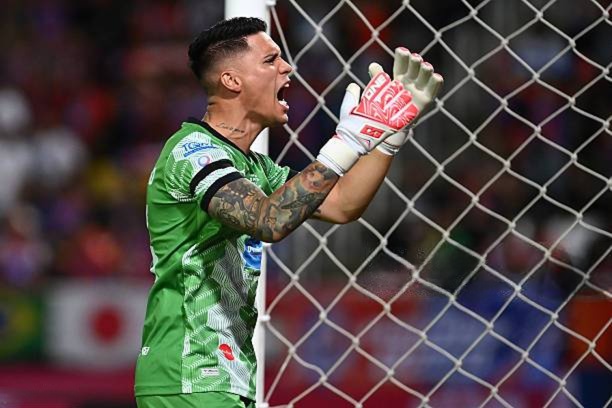
Michael Falkesgaard has built a long, well-travelled career on adaptability — Brøndby, OB, Midtjylland, a switch of international allegiance to the Philippines, a first spell at Bangkok United, a return to Denmark with B.93, and now, into his second season, Port FC. That adaptability is being tested again this year. The Danish-born, Filipino-naturalised goalkeeper, 35, is part of a Port squad being reshaped more dramatically than at any point since he arrived in Thailand, after this summer’s abolition of the ASEAN foreign-player quota that once reserved a handful of starting slots for regional players like him — a change we covered in detail in our club-by-club season preview. Port’s squad has responded by recruiting heavily from Brazil. Falkesgaard’s response, he tells Football Siam, has been to embrace it.
A dressing room rebuilt in Portuguese
“You can feel there’s more of a foreign space in the dressing room now, with more players coming from Brazil,” Falkesgaard says, sounding genuinely more curious than concerned about how fast a changing room’s centre of gravity can shift. “It’s going to take quite a lot of balancing for the coaching staff to get the squad right, but we have a strong mentality and a good group. I don’t think it’ll be a problem.”
That confidence isn’t idle. Falkesgaard points to a deliberate effort, in which he was clearly an active participant, to build cohesion early — the Piala Presiden warm-up tournament in Indonesia first, then a lengthy pre-season training camp on Koh Samui capped off with a squad boat trip. “That was one of the main reasons for the trip. We needed the feeling that we’re in it together from game one.” It is exactly the kind of unglamorous, senior-professional groundwork that rarely makes headlines but tends to matter enormously in a squad reshaped this quickly — and it is precisely the role experienced heads like Falkesgaard are there to play.
Two coaches, one philosophy
The man picking the team has changed too, though perhaps not as violently as the quota rules would suggest. Alexandre Gama, the Brazilian coach who built the platform for Port’s runners-up finish last season, left the club in May after a frightening bout of pneumonia — an ordeal he described to Football Siam in his own words shortly after his recovery in Brazil. Sarawut Treephan, promoted from caretaker to permanent charge, saw out the run-in and added the Thai League Cup to the collection, beating BG Pathum United in the final to end a 16-year wait for the trophy. Falkesgaard, asked to compare the two regimes, speaks about both with evident respect.
“Coach Oud and Gama are two different coaches,” he says. “Already last season he tried some minor changes when he came in, but there wasn’t a big desire to change too much because we were doing great. This season he’s doing his own thing, and of course there are some changes to the tactics we’re trying to implement.” Formation, he insists, is almost beside the point. Port shifted from a back-three-supported 4-3-3 for most of last season into something closer to a 4-4-2 against Rasisalai’s back five, before reverting once fresh legs came on. “For me the formation isn’t that important. It’s more about how we adapt to the opposition, and about playing to the strengths of whoever’s on the pitch. Fast formation, we call it.”
The five-front gamble
Port’s runners-up finish and cup win earned them a first crack at the AFC Champions League Elite, alongside an outing in the ASEAN Club Championship — five competitions in total, a workload that stretched Bangkok United thin with injuries and fixture pile-ups last term. Continental home games, for now, are being staged at Thammasat Stadium rather than the compact, atmospheric bowl of PAT Stadium in Khlong Toei. It’s a compromise Falkesgaard accepts with the same even-headed pragmatism that runs through his outlook on the season as a whole.
“Everyone wanted to play at home at PAT Stadium — that’s where we’re most comfortable, and it gives us that extra edge,” he says. “The trip to Thammasat isn’t ideal, but the stadium itself isn’t bad. I hope we can bring that atmosphere there too, though I know it’ll be tough, especially on a weekday.” He speaks with the perspective of a player who has seen leagues and squads tested by fixture congestion before. “You saw how that ended for Bangkok United last season, with all the travelling and injuries. If we can keep a healthy squad and keep the confidence in the team, even against difficult opponents in the Champions League, we can aim high this season too.”
The new front three
Nowhere has the summer’s ambition been more visible than up front, and Falkesgaard has been generous in his assessment of the new arrivals. Jude Soonsup-Bell, the Chelsea academy product whose stalled career at Grimsby Town prompted a certain amount of scepticism in this publication back in August, has clearly won over his new teammate already. “He’s a really good guy — young, coming in from England, so of course he’s had to adapt to the Thai mentality and the culture,” Falkesgaard says. “He has everything a striker needs to have success. It’s about working hard and keeping his head on track. If he stays healthy and finds the net, I think he can have a great first season.”
He is equally warm about Issam Al-Sabhi, the Omani international arriving from Iraqi side Al-Quwa Al-Jawiya on a free transfer — a player with 24 goals in 73 caps for his country and, on Falkesgaard’s account, a keen eye for goal already carried over from pre-season. “He’s been really clinical, both in pre-season and at the end of last season internationally,” he says, before adding that Teerasak Poeiphimai remains “certain of ten goals at least” — competition Falkesgaard welcomes rather than resents, framing it as exactly the kind of forward-line depth a five-competition campaign demands.
At the back, Erik Sviatchenko has arrived from MLS side Houston Dynamo to replace the departing Rebin Sulaka — a swap Falkesgaard, characteristically gracious, calls bittersweet but an upgrade in pedigree. “It’s sad to see Ruben leave, but I think it’s an upgrade with his pedigree,” he says of the former Celtic and Danish international centre-back. “Everyone who’s played with him knows he’s a leader — someone who maximises everything he can and never settles.” Thailand’s overlapping international commitments compounded the disruption; several regulars returned only days before the opener, still catching up on the bonding forged in Koh Samui. “We lost a lot of that connection time with the new players,” Falkesgaard says. “But most of the group has been here a while — it’s only two or three who are genuinely new. We’ll help them settle, and game by game, we’ll get stronger.”
Readers wanting more on that particular arrival won’t have long to wait — Football Siam sits down with Sviatchenko himself next week for a full interview on his move from MLS to Khlong Toei.
Realistic ambition
For all the upheaval — the quota change, the coaching transition, the five fronts — Falkesgaard’s own outlook remains refreshingly clear-eyed and ambitious in equal measure.
“Like every season, we aim to be champions. That must be the target. But we also have to be realistic. We’re going to play against teams as good as us, some with bigger budgets. Still, we need to aim for the top.”
It’s the outlook of a player who has seen enough of this league, and enough of this club, to know that patience and squad depth count for as much as individual moments over a season this demanding. Port’s title defence has already started better than most predicted, and if that early cohesion owes something to the culture senior professionals like Falkesgaard help build, that’s a contribution that rarely shows up on a scoresheet but rarely goes unnoticed in a dressing room either.
Port FC’s next Thai League 1 fixture is at PAT Stadium this Friday.
 Buriram United
 Rayong
 Uthai Thani
 Prachuap
 Bangkok United
 Port
Port Ayutthaya United
 Pathum United
 Ratchaburi
 Chiangrai United
 Pattani
 Sukhothai
 Sisaket United
 Rasisalai United
 Lamphun Warrior
 Chonburi