
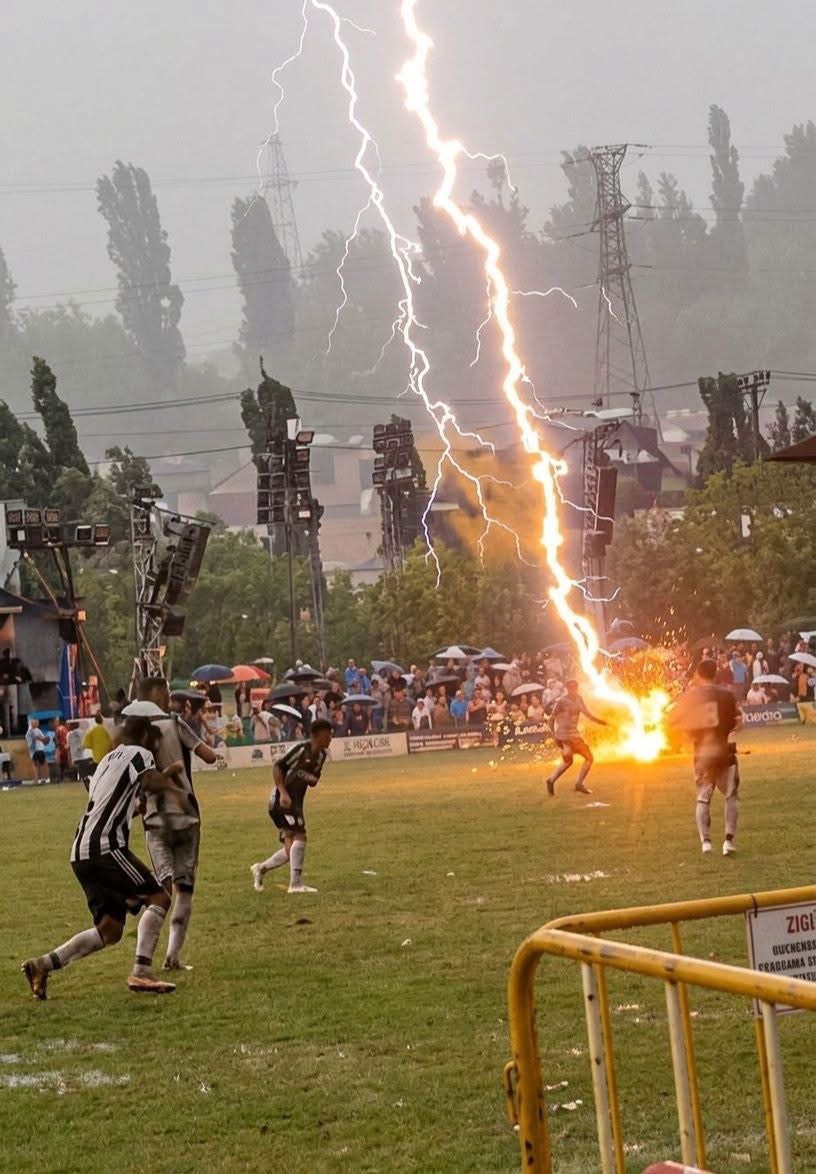
The devastating news emerging from Narathiwat should bring the entire Thai football community to a standstill. On August 4, tragedy struck at the Santiphap Stadium in Sungai Kolok during a Golok friendly cup match. Amidst a violent thunderstorm, 24-year-old winger Sofwan "Ing" Awae was killed by a direct lightning strike that also left seven other players injured.
Sofwan was a talent with his best years ahead of him. The former Pattani FC number 17 had only recently put pen to paper with Thai League 3 side FC Yala, ready to embark on a new chapter in his professional career. Instead, he lost his life on the pitch, his teammates left desperately attempting to revive him after a bright streak of light tore through the penalty area at around 5:30 pm.
Misplaced Priorities and the Monsoon Calendar
This tragic loss must immediately become the front-and-centre issue for the Football Association of Thailand. Right now, the national football discourse is too often hijacked by the circus of foreign takeovers—such as the recent Egyptian boardroom drama—or the tedious logistics of arguably pointless ASEAN cup competitions. These are mere distractions from the existential, structural issues that are genuinely costing lives and ruining the domestic game.
The root of this particular crisis is scheduling. When the Thai football calendar was controversially moved to align with the European season, it inadvertently pushed a significant portion of the fixture list squarely into the monsoon season. For clubs in the South, this is not just a minor inconvenience; it is a fundamental threat to safety. We need a comprehensive strategy to deal with the reality of monsoon football. This includes mandating proper drainage to prevent waterlogged, dangerous pitch conditions, addressing the severe travel risks for teams navigating flooded infrastructure, and ensuring that fan safety and matchday enjoyment are not entirely compromised by torrential downpours.
The Science of the Strike: Why the Pitch is a Danger Zone
In the wake of such a horrific event, a dangerous myth often circulates: the assumption that a stadium’s towering floodlights or grandstands act as a protective umbrella, drawing any lightning strikes away from the exposed pitch. The science of lightning proves this to be a fatal misconception.
The Blind Descent of the Stepped Leader
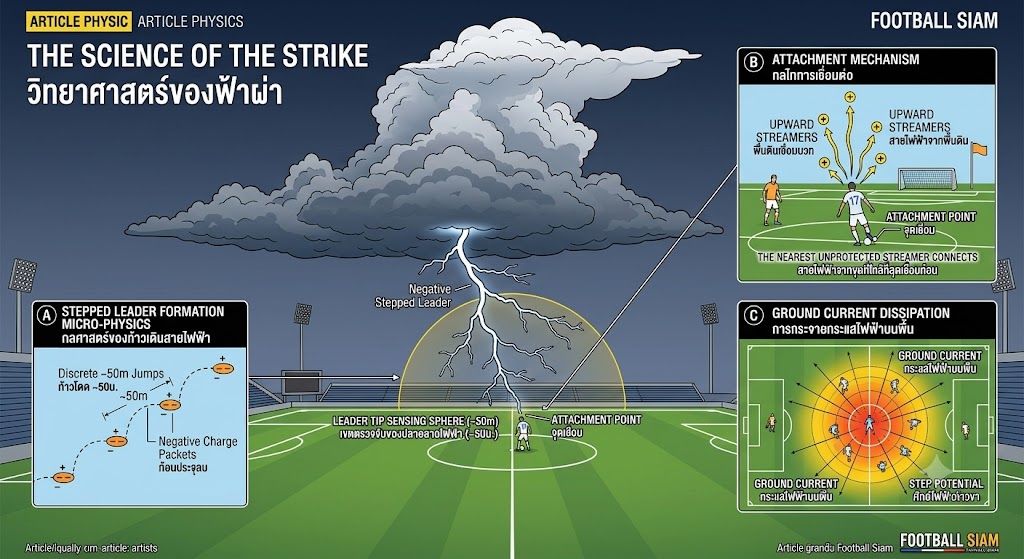
A lightning flash typically begins with a negatively-charged channel of air descending from a thundercloud, known as a "stepped leader". These leaders travel downwards in quick, discrete steps that are typically about 50 metres in length. Crucially, a stepped leader does not calculate the path of least resistance from the cloud directly to the tallest object on the horizon. Instead, its tip only senses electrical conditions within a radius of about 50 metres.
Because a football pitch is a vast, open space—often over 100 metres long—a stepped leader descending over the middle of the grass is completely unaware of a tall light tower 50 or 60 metres away. As it reaches the surface, objects on the ground shoot invisible paths of positive charge upwards, called "upward streamers". If a player is standing beneath a descending stepped leader, an upward streamer from their body may connect with the negative charge first. In that split second, the player becomes the path of least resistance.
The Invisible Threat: Ground Current
Even if a player avoids a direct strike, they are still in extreme peril due to a phenomenon known as ground current, or step potential. This explains how seven other players were injured alongside Sofwan.
When lightning strikes the earth, the massive electrical charge dissipates horizontally across the surface. Because human bodies are largely composed of salt water, they are much better electrical conductors than wet grass. If a player is standing with their feet apart, the electricity can travel up one leg, pass through their body, and travel down the other leg. Ground current is responsible for up to 50% of all lightning-related injuries, causing mass casualties even when only one person takes a direct hit.
A History of Warnings
Football has a grim history with lightning. In 2004, 18-year-old Jiang Tao of the S-League side Sinchi FC was killed during a training session in Singapore. We’ve seen similar recent tragedies in Indonesia, and famously in the Democratic Republic of Congo in 1998, where an entire team was reportedly struck down. We cannot pretend this is an unforeseeable freak occurrence in a tropical region.
The FA needs to stop looking outward and start fixing the foundations at home. It is entirely unacceptable to leave players exposed to extreme weather without a rigorous, universally enforced lightning protocol. If we look across the border to Singapore, their Meteorological Service uses islandwide detection networks to trigger 'Category 1' weather status alerts, mandating an immediate halt to play and the clearance of open fields. Thai football desperately requires similar real-time weather monitors and strict, non-negotiable suspension protocols.
Thai football has lost a bright young talent. If the FA does not treat this as a definitive wake-up call to reassess the practical realities of the football calendar and institute modern weather monitoring systems, Sofwan Awae’s passing will be compounded by a failure to protect those who take to the pitch next.
Next tour: Port v Rayong
Saturday 24 October 2026 · ฿3,900 ฿2,999 per person, all inclusive. Ticket, private transport, pre-match briefing and a guide who knows the league inside out.
Book Your Place →