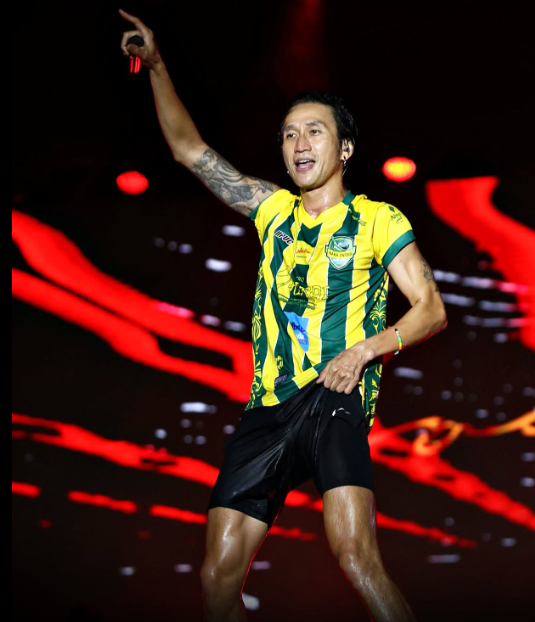
When Thai rock icon Toon Bodyslam stepped onto the stage at the Narathiwat Music Festival wearing the green and yellow jersey of Nara United, the roar from the local crowd carried a hollow, distinctly bittersweet ache. Behind the band, a massive stadium screen flashed a poignant lyric: "Going out to touch the horizon, but it seems fate doesn't understand."
It was a devastatingly accurate summary of the summer of madness surrounding the "Southern Kolas". On the pitch, Nara United had done everything right. They fought their way to the Southern Zone Championship, conquered the brutal knockout format of the Thai League 3 Champions League, and joyfully secured promotion to the professional ranks of Thai League 2. They had touched the horizon.

Yet today, in the sterile boardrooms of Bangkok, that sporting triumph has been utterly erased. As the Football Association of Thailand (FA) convenes to finalise the official league structures for the 2026/27 season, Nara United will not be on the second-tier roster. In an unprecedentedly harsh ruling, the First Instance Body (FIB) hasn't just blocked their promotion; they have stripped the club of its professional status entirely. Because the club failed to secure a licence for either Tier 2 or Tier 3, they have been administratively relegated to the amateur Thailand Semi-Pro League (TSP).
The emotional fallout in Narathiwat province is immense, but this was no sudden ambush by regulatory authorities. It was a slow-motion institutional car crash that exposes the fragile corporate governance underpinning the lower echelons of Thai football.
The Concrete Charges: Death by Bureaucracy
To understand the scale of this administrative disaster, one must look past the emotional headlines and examine the cold, clinical reality of the CLAS (Club Licensing Administrative System) database. The FA had extended submission deadlines from March to May, and issued a final warning letter on 8 June. When the absolute final digital upload window slammed shut on 19 June, Nara United’s profile was a graveyard of red flags.
Club Licensing Failure Breakdown
| Category | Specific Failure |
|---|---|
| Sporting | Omitted formal youth development curriculum and mandatory medical examination records for academy players aged 12 and above. |
| Infrastructure | Failed to submit an official stadium emergency evacuation plan for their home ground. |
| Personnel & Admin | Failed to upload corporate legal group structure and completely neglected to provide signed professional employment contracts for the first-team squad. |
| Financial | Left a total informational vacuum regarding "subsequent financial events", failing to prove post-promotion financial stability. |
Criteria S.01 & S.03: The club completely omitted their formal youth development curriculum (S.01) and failed to provide mandatory medical examination records for academy players aged 12 and above (S.03).
Criteria I.03: The club failed to submit an official stadium emergency evacuation plan for their home ground, a fundamental safety requirement for professional competition.
Criteria L.04 & L.05: The management failed to upload their corporate legal group structure (L.04) and, incredibly, neglected to provide copies of signed professional employment contracts for their first-team playing squad (L.05).
Criteria F.07: The club left a total informational vacuum regarding their "subsequent financial events"—essentially failing to prove they could cover their updated post-promotion financial obligations.
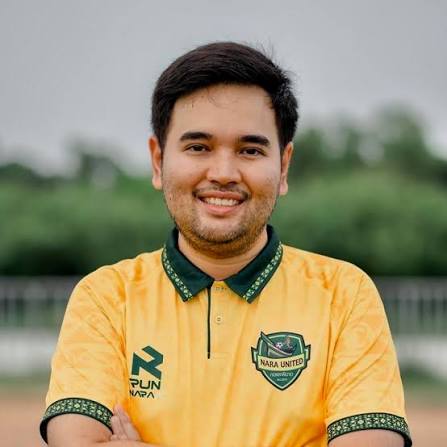
In the wake of the FIB’s crushing decision, Nara United President Affan "Bae Fan" Mahama took to a live broadcast to address the crisis. He was defensive but transparent, offering a public confession:
Affan Mahama: "I admit it fully: we genuinely messed up. This was entirely an internal administrative failure and a personal oversight where our staff simply failed to submit a complete set of documentation."
Affan maintained that the club's legal team would lodge an appeal on 14 July, though he realistically pegged their survival chances at a mere 30%. He also went out of his way to deny rampant local rumours of political interference, asserting that his relationship with local political figures remained perfectly sound.
Yet, as the pieces of the puzzle begin to settle, a far more cynical picture is emerging from the deep south.
Smoke, Mirrors, and the Boardroom Fracture
The official narrative tells a story of tragic administrative incompetence—a small-town club overwhelmed by modern corporate box-ticking. However, high-level whispers within the game suggest that the licensing failure was not an accident at all. Instead, it appears to have been a convenient smokescreen masking a fatal internal boardroom war.
Recently, while having dinner with a highly respected, veteran first-team coach in Thai football, the reality of Nara's internal chaos unfolded in real-time. Mid-meal, the coach received a direct phone call from the Nara United ownership group. They were aggressive, formal, and offered him the head coaching job immediately, explaining they wanted him to steer their ambitious new Tier 2 campaign. The coach politely declined, citing his commitment to his current project, but offered to introduce them to another well-established, highly capable manager who would fit the bill perfectly. The Nara executives were delighted and told him to make the introduction.
Less than an hour later, the phone rang again. The search was abruptly off. The Nara official advised the coach not to bother making the introduction, revealing that a massive, irreconcilable falling out between the co-owners had just occurred. The current iteration of the club, he was told, would not be moving forward under any circumstances.
This single interaction entirely changes the complexion of the scandal. If the club’s leadership fractured beyond repair weeks ago, the subsequent failure to upload player contracts and financial documents into the CLAS system was not an oversight. It was a tactical surrender. By allowing the club to die a quiet, bureaucratic death at the hands of the FIB, the remaining power brokers avoided the public stain of a folding franchise, leaving themselves entirely free to pivot their energy, political capital, and financial resources into a separate, untainted entity: Nara FC.
Affan Mahama practically confirmed this fallback strategy in his broadcast, noting that while Nara United might be dead, the separate Nara FC shell had successfully navigated its Tier 3 licensing audit. "I am man enough to take responsibility," Affan stated, "and I promise the fans I will bring professional football back under Nara FC at the very least."
A Broken System: Why Club Licensing Must Be Overhauled
Whether Nara United's demise was born of genuine administrative ineptitude or deliberate corporate sabotage, the saga has exposed a professional licensing framework that is fundamentally broken and entirely unfit for purpose. The current reactive system punishes fanbases, commercial partners, and rival clubs alike by allowing structural rot to hide behind sporting success until it is far too late.
Under the current rules, a club can gamble beyond its means, sweep through a season, and win promotion on the pitch, only to pull the rug out from under the entire league ecosystem months after the final whistle has blown. This leaves administrative bodies scrambling in July to patch up fixture lists for a season starting in September.
A proactive, future-proof league system requires a total overhaul of the administrative timeline. The solution is simple: licensing must precede the playoffs.
Every single Tier 3 club should be mandated to apply for a combined T3 and T2 license at the very beginning of the regular season. If an ambitious club harbours desires for promotion, their corporate structure, infrastructure safety plans, and financial guarantees must be audited dynamically throughout the year.
If a club fails to meet Tier 2 criteria during the initial audits, the FA should hand them a strict, non-negotiable rectification checklist with a hard deadline of January 1st. If a club cannot prove absolute operational compliance by the turn of the year, they must be categorically barred from entering the post-season Champions League playoff round. Their playoff spot should automatically pass to the next highest-placed team in the zone that actually boasts a verified corporate foundation.
The human cost of the FA’s current retroactive approach is severely illustrated by the plight of Yala FC.
Yala finished a highly commendable third in the Tier 3 Southern Zone, narrowly missing out on the Champions League playoffs while Nara United advanced. Today, Yala FC has every right to feel bitterly aggrieved. Their players, staff, and fans were denied the opportunity of a lifetime, sacrificed so that a fractured Nara United hierarchy could chase a promotion they were ultimately incapable—or entirely unwilling—to actually sustain.
The exact same preventative logic must be extended to the amateur ranks of the Thailand Semi-Pro League. Clubs should be forced to secure a conditional Tier 3 licence before they are allowed to enter the TSP promotion tournaments. Allowing under-resourced, administratively blank setups to achieve promotion on the pitch, only to watch them disintegrate under a basic audit weeks later, is a waste of time, money, and sporting integrity.
The Domino Effect
While Nara United prepares for an execution today that their own leadership group actively facilitated, a frantic, highly undignified scramble is taking place across the rest of the country as standby clubs look to feast on the remains. And the chaos isn't limited to Nara. News has emerged that Trat FC have also completely failed their Club Licensing, opening up a secondary, massive vacancy right in the middle of Thai League 2.
First-choice replacement. Cleared with conditional approval using Pitchaya Stadium as their designated ground-share.
As the spot was vacated by a fellow T2 side, Kasetsart get the first opportunity to claim the vacancy.
Next in line to inherit the Nara spot if Muang Loei fails final executive committee approval.
Remaining in the queue for potential administrative default adjustments.
Muang Loei United currently sits at the front of the queue to inherit the Tier 2 spot vacated by Nara United. They have passed their licensing audit, but it highlights the league's shifting logistics: they have been granted conditional approval by submitting a ground-sharing agreement to play at **Pitchaya Stadium** while their primary home ground undergoes rushed renovations. Should Muang Loei run into unexpected final roadblocks, the regulations dictate that **Nakhon Si United** stands next in line to step up.
Simultaneously, the collapse of Trat FC creates a completely different route of succession. Because Trat is a Tier 2 club vacating a Tier 2 spot, it is **Kasetsart FC** who get the first opportunity to step into that specific breach. Meanwhile, Uttaradit FC—who are already directly in the mix for the upcoming campaign on their own merit and are not acting as a replacement for anyone—face their own strict race against time. They have been handed a mandatory list of compliance actions to complete, with **Phrae United's stadium** officially lined up as their designated back-up ground should their home facilities lag behind. If any more dominoes tumble among the standby list, Bangkok FC wait patiently as the fourth choice to reclaim a place on pure administrative default.
Ultimately, this entire saga stands as a sharp indictment of the short-termist gambles plaguing the lower divisions. Until the federation stops treating corporate sustainability as secondary to on-pitch drama, league structures will remain deeply fragile. Proving that a club can stand on its own two feet without resorting to logistical or administrative high-wire acts should be the baseline expectation—not the exception.
The Boardroom Reckoning
As the FA Executive Committee concludes its meeting today, the fate of the Southern Kolas is all but sealed. The tragedy is not that Nara United lost their place in professional football; it is that the system allowed them to ride their luck far enough to damage the integrity of the leagues.
Thai football cannot continue to treat Club Licensing as a post-season afterthought. Until the FA demands institutional accountability before the first ball is kicked in the playoffs, the beautiful game in Thailand will remain utterly vulnerable to the exact brand of smoke, mirrors, and boardroom warfare that has just broken hearts across Narathiwat.
Next tour: Port v Rayong
Saturday 24 October 2026 · ฿3,900 ฿2,999 per person, all inclusive. Ticket, private transport, pre-match briefing and a guide who knows the league inside out.
Book Your Place →