Four days before Indonesia beat Thailand on penalties at Gelora Bung Karno, Mitchell Baker scored his fifth goal against Bangladesh in the seventh minute of stoppage time. That goal did not just put Indonesia in the final. It decided who Thailand would play, where the crowd would be, and what kind of night it would become.
Thailand did not lose the ASEAN Cup final on Monday 5 October. They lost it the previous Thursday, at about twenty past nine in the evening, in a match they were not playing and most of their supporters were not watching.
At the Gelora Bung Karno, Indonesia were beating Bangladesh 7-2 and it was not enough. Across in Bandung, Malaysia had finished 6-0 against Singapore. Both sides sat on seven points. They had drawn 0-0 with each other, so head-to-head could not separate them. Goal difference could: Malaysia +9, Indonesia +7. With ninety minutes played, the hosts of this tournament, the team built at vast expense to win it, were going out at the group stage on goal difference to a Malaysia side ranked 136th in the world.
Kevin Diks scored in the sixth minute of added time. Eight-two, goal difference +8. Still out. Then, in the seventh, Baker, a nineteen-year-old who had been an Indonesian citizen for eleven weeks, scored his fifth of the night. Nine-two. Goal difference level at +9, and the next tie-breaker is goals scored: Indonesia eleven, Malaysia nine. Indonesia were through. Malaysia, who had not conceded a goal, were in the bronze match.
Everything that happened to Thailand afterwards flows from that minute.
The thirteen minutes that chose Thailand’s opponent
Group A, Thursday 1 October · Indonesia v Bangladesh (GBK) and Malaysia v Singapore (Bandung), both 19:30
- 84′Luke Vickery makes it 7-1 in Jakarta. Malaysia 4-0 up in Bandung.Indonesia through on GD (+8 v +7)
- 87′Syahir Bashah, Malaysia 5-0.Level on GD; Indonesia ahead on goals scored, 9 v 8
- 90+3′Bergson da Silva completes Malaysia’s 6-0.Malaysia through, +9 v +8
- 90+5′Farhaan Ali Wahid pulls one back for Bangladesh. 7-2.Malaysia, +9 v +7
- 90+6′Kevin Diks. 8-2.Malaysia, +9 v +8
- 90+7′Mitchell Baker, his fifth. 9-2.+9 each; goals scored 11 v 9 · Indonesia through
Tie-breakers in order: head-to-head (0-0), goal difference, goals scored. Goal times from the Detik match report.
Group A, final table
Decided on goals scored
| Team | P | W | D | L | GF | GA | GD | Pts |
|---|---|---|---|---|---|---|---|---|
| Indonesia | 3 | 2 | 1 | 0 | 11 | 2 | +9 | 7 |
| Malaysia | 3 | 2 | 1 | 0 | 9 | 0 | +9 | 7 |
| Singapore | 3 | 1 | 0 | 2 | 1 | 8 | -7 | 3 |
| Bangladesh | 3 | 0 | 0 | 3 | 2 | 13 | -11 | 0 |
Eighteen months, four countries
It helps to know who scored it, because the route is the point.

Player card
Mitchell Baker
Centre-forward · Indonesia and Georgetown · Colorado Rapids (2026 draft, pick 10)
Age
Height
Indonesia
ASEAN Cup 2026
Debut
v Bangladesh
Georgetown 2025
Citizen since
- Hong Kong FCacademy
- Northcote City2020
- Melbourne Victoryacademy, 2021
- Northwood SchoolNY, 2022–24
- Georgetown2024–
- Malvern CityState League 1, 2025
- Colorado Rapidsdrafted Dec 2025
- IndonesiaJul 2026–
Career data from Georgetown Athletics, Bola.com, Football360 and FIFA match reports. International figures to 5 October 2026.
Mitchell Baker was born in Melbourne on 11 December 2006. His mother, Maureen Lee Baker, is the daughter of a father born in Yogyakarta in 1937 and a mother from Semarang. He spent part of his childhood in Hong Kong, in the Hong Kong Football Club academy, and was back in Melbourne by 2020, playing junior football at Northcote City from 2020 and in the Melbourne Victory academy in 2021. He was Scotch College’s top scorer and player of the year.
Then, at fifteen, he left. In 2022 Baker moved to Northwood School in upstate New York, a boarding school whose football programme runs alongside the Black Rock FC club, with the stated aim of using the game to help pay for a university education. He scored 141 goals there in roughly two and a half years, won back-to-back golden boots and was named a high-school All-American in 2023. Georgetown signed him in April 2024.
His first college season, in autumn 2024, was modest: four goals and four assists in 21 matches. This is the part that lends the story its shape. In 2025 Baker also turned out for Malvern City in Victorian State League 1, the fourth tier of football in the state, a league of suburban grounds and a few hundred spectators. He was 18. By any ordinary reading of a footballer’s career, that is where he was.
What followed was anything but ordinary. Back at Georgetown for the autumn of 2025 he scored 14 goals in 21 starts, five of them winners, led the Big East in that category, was named a second-team All-American and reached the semi-final stage of the MAC Hermann Trophy, the award for the best player in American college soccer. On 18 December the Colorado Rapids took him tenth overall in the MLS SuperDraft. He has two years of college eligibility left and is still, as of this autumn, Georgetown’s number nine.


Then Indonesia moved. On 13 July 2026 Baker took the oath of citizenship at the Ministry of Law in South Jakarta, renouncing his Australian passport in the process. Fourteen days later, on 27 July, he made his debut against Cambodia at Pakansari and scored a hat-trick inside 56 minutes. He was substituted two minutes after the third. By the time Bangladesh arrived at Gelora Bung Karno on 1 October, he had four international goals from six caps, 196 centimetres of centre-forward, and an Instagram following counted in the hundreds of thousands, almost all of it acquired since July.
State League 1 to a FIFA tournament final in eighteen months. It is the kind of arc that tends to produce a single defining moment, and his came in the 97th minute against the 181st-ranked side in the world.

Two very different finals
Thailand v Malaysia: a near-neutral GBK, an opponent Thailand had beaten 2-0, 1-0 and 3-0 in their last three meetings, and a defence untested by a front line of Thailand’s class.
Thailand v Indonesia: 67,000 in red, a squad assembled to end six lost finals, four of them to Thailand, and a night Jakarta had been promised for a fortnight.
Consider the two finals Thailand might have played. Both were at Gelora Bung Karno; the venue was fixed before a ball was kicked. The difference was who filled it.
Against Malaysia, Thailand would have walked into a stadium that was, at worst, indifferent to them. Jakarta would have had no horse in the race. Malaysia would have brought a few thousand, Thailand a few hundred, and the match would have been played in the kind of hush that lets a technically superior side think. And Thailand were the technically superior side. They had beaten Malaysia in each of the last three meetings, including 2-0 in August, without conceding. Malaysia’s tournament had been built on not conceding either, ten goals scored and none let in across four matches, but it was a defence that had been tested by Bangladesh, Singapore, a ten-man Indonesia and Vietnam, not by Thailand’s front line.
A caveat is owed here, because the counterfactual cuts both ways. Malaysia were not a soft option. They went through the tournament without conceding, they have beaten Thailand more often than Thailand have beaten them across 109 meetings, and they beat Thailand in the 2010 final, though Thailand took the 2014 one. A Malaysia final could have been lost too, most plausibly 1-0 to a set piece in a quiet stadium, the kind of match that technical superiority alone does not win. The argument is not that Thailand would have won. It is that the final they got was the harder one, and that the thing which made it harder was not the opponent’s quality but the opponent’s crowd.
Against Indonesia, Thailand walked into a national occasion. Around 67,000 people, almost all of them in red, a federation that had spent years and a great deal of money assembling a squad specifically to end a record of six lost finals, four of them to Thailand, and a match that Indonesia’s own press had framed for a fortnight as the night the old order ended. The noise at Gelora Bung Karno is not a metaphor. It changes how long a player holds the ball, how a referee hears an appeal, and how a back four behaves in the last ten minutes of extra time.
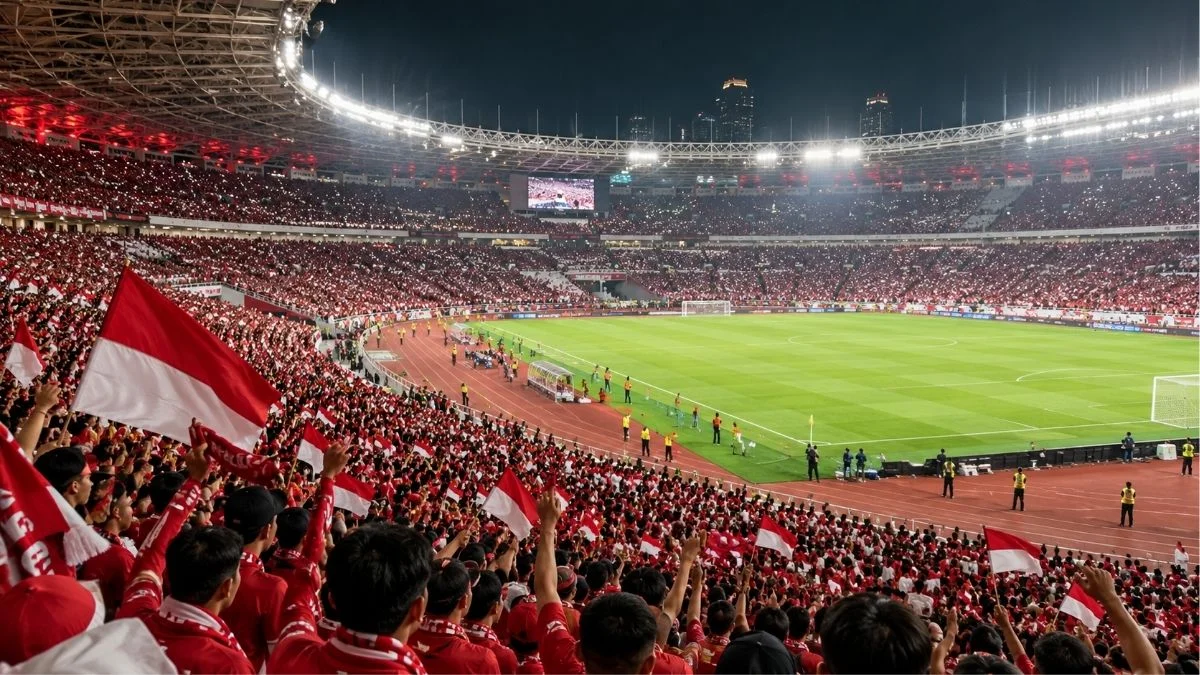
Baker’s goal turned a neutral final into an away final. That is its first effect on Thailand, and it is the one nobody in Bangkok will want to hear, because it means the margin between winning and losing this tournament was not in Thailand’s hands at all.
Indonesia needed every bit of GBK to beat Thailand, and GBK was only there because of Baker.
What the home crowd bought
It is worth being precise about how the final was actually lost, because the crowd did not score the goals.
Thailand went down to ten men in the 81st minute when Nicholas Mickelson collected a second yellow card. Three minutes later Dean James’s free-kick deflected off Iklas Sanron and in. Thailand, with ten, equalised through Iklas in the 87th, went ahead through Peeradol Chamratsamee in the 111th minute, and conceded to Elkan Baggott in the 116th. The shootout went 4-2 to Indonesia; Sarach Yooyen hit the post, Audero saved from Sayriya.
Three of those moments are home-crowd moments. A second yellow for a full-back on 81 minutes in a tight final is a decision a referee makes under pressure, and the pressure at GBK is all one way. A set-piece goal from a deflection in the 84th minute is the kind of thing that happens when a team has been pinned back for ten minutes by a stadium that will not let the ball leave its half. And a 116th-minute equaliser against ten men who have been defending a lead for five minutes is what exhaustion looks like when 67,000 people are counting it down.
None of that happens, or at least none of it happens in the same way, against Malaysia. Indonesia needed every bit of GBK to beat Thailand, and GBK was only there because of Baker.
The team that was supposed to lose
There is a second, subtler effect, and it is about Thailand’s own psychology.
Thailand had beaten Indonesia in four ASEAN finals. Indonesia had never won one. Whatever Anthony Hudson said in the dressing room, every Thai player walked out on Monday knowing that this was the opponent Thailand do not lose finals to. It is the kind of knowledge that is a comfort for eighty minutes and a weight for the last forty, because the longer the match stays level, the more the history becomes something to protect rather than something to use.
Against Malaysia the history, as noted, is less flattering, and Thailand’s three straight wins over them are all recent. A Malaysia final would have been a match Thailand expected to win on form. An Indonesia final was a match Thailand expected to win on history, which is a far less reliable thing to expect it on.
Baker, incidentally, did not score in the final. He did not need to. His work was done on Thursday.
The goals-scored rule
There will be a temptation in Thailand to treat the tie-break as a quirk, a line in the regulations that happened to fall Indonesia’s way. It was not a quirk. It was a rule Indonesia knew about, planned for, and executed under pressure in a way that tells you something about the side Thailand lost to.
At 7-2 with ninety minutes played, Indonesia did not need a goal. They needed two, and they needed them against a Bangladesh side that had just pulled one back and was defending in numbers. John Herdman’s players did not panic, did not shoot from forty yards, and scored twice in two minutes through a centre-back and a striker who had been Indonesian for eleven weeks. It was the most ruthless passage of play in the tournament, and Thailand, who scored seven in three group games and then rotated their way to defeat against the Philippines, never had to produce anything like it.
That Philippines defeat deserves a line of its own. Thailand lost 1-2 in Bandung on 2 October with a changed side, having already qualified. It cost them nothing on paper. But it meant Thailand arrived at the final having lost their last match, while Indonesia arrived having scored nine in theirs. Momentum is an overused word in football. It is not a meaningless one.
What it means
Thailand were not the worst team in this tournament. They had the best midfield in it, they beat Vietnam for the first time in years, they went 2-1 up with ten men in a final in front of 67,000 people, and they lost on penalties. Nobody should pretend that is a disaster.
But it is worth being honest about what the ASEAN Cup turned on, because it was not anything Thailand did. It turned on a nineteen-year-old from Melbourne, a State League 1 forward eighteen months ago, scoring in the 97th minute of a 9-2 win against the 181st-ranked side in the world. That goal gave Indonesia the final, gave Indonesia the crowd, gave Indonesia the referee’s ear and the last five minutes of extra time, and gave Thailand an opponent that had spent years preparing for precisely this night.
Indonesia built a squad to make a moment like that possible. Thailand have been having the argument about whether to build one at all for a decade. On Thursday 1 October, at twenty past nine, that argument was settled by somebody else.
Next tour: Port v Rayong
Saturday 24 October 2026 · ฿3,900 ฿2,999 per person, all inclusive. Ticket, private transport, pre-match briefing and a guide who knows the league inside out.
Book Your Place → Buriram United
 Uthai Thani
 Bangkok United
 Prachuap
 Port
Port Ratchaburi
 Rayong
 Ayutthaya United
 Sisaket United
 Pathum United
 Chiangrai United
 Pattani
 Sukhothai
 Rasisalai United
 Lamphun Warrior
 Chonburi